
If your garage turns into an oven every summer, the door is almost certainly the problem. An uninsulated metal garage door conducts heat like a frying pan — and in hot climates like Texas, Arizona, or Florida, that heat bleeds into your home, spikes your AC bills, and makes the garage unusable for half the year. The right garage door insulation for hot climates fixes this without replacing the entire door. This guide covers the best options available in 2026, with real R-values, product recommendations, and a straight answer on what actually works in extreme heat.
What Makes Insulation Work in Hot Climates?
Hot climate insulation is different from cold climate insulation. In cold weather, you want to trap heat inside. In hot weather, you want to reflect radiant heat before it enters. This is why R-value alone does not tell the whole story for hot climates.

There are two types of heat transfer to block:
- Conductive heat — heat moving through the door material itself. Blocked by foam insulation with high R-value.
- Radiant heat — infrared heat radiating from the sun directly onto the door surface. Blocked by reflective (radiant barrier) insulation.
In hot climates, radiant heat is the bigger problem. A metal garage door facing the afternoon sun absorbs radiant heat all day and radiates it into your garage for hours after sunset. Reflective insulation with a radiant barrier addresses this directly — blocking up to 95% of radiant heat before it ever enters the door.
Best Garage Door Insulation for Hot Climates: Top Picks
1. Reach Barrier 3009 Garage Door Insulation Kit — Best Overall for Hot Climates
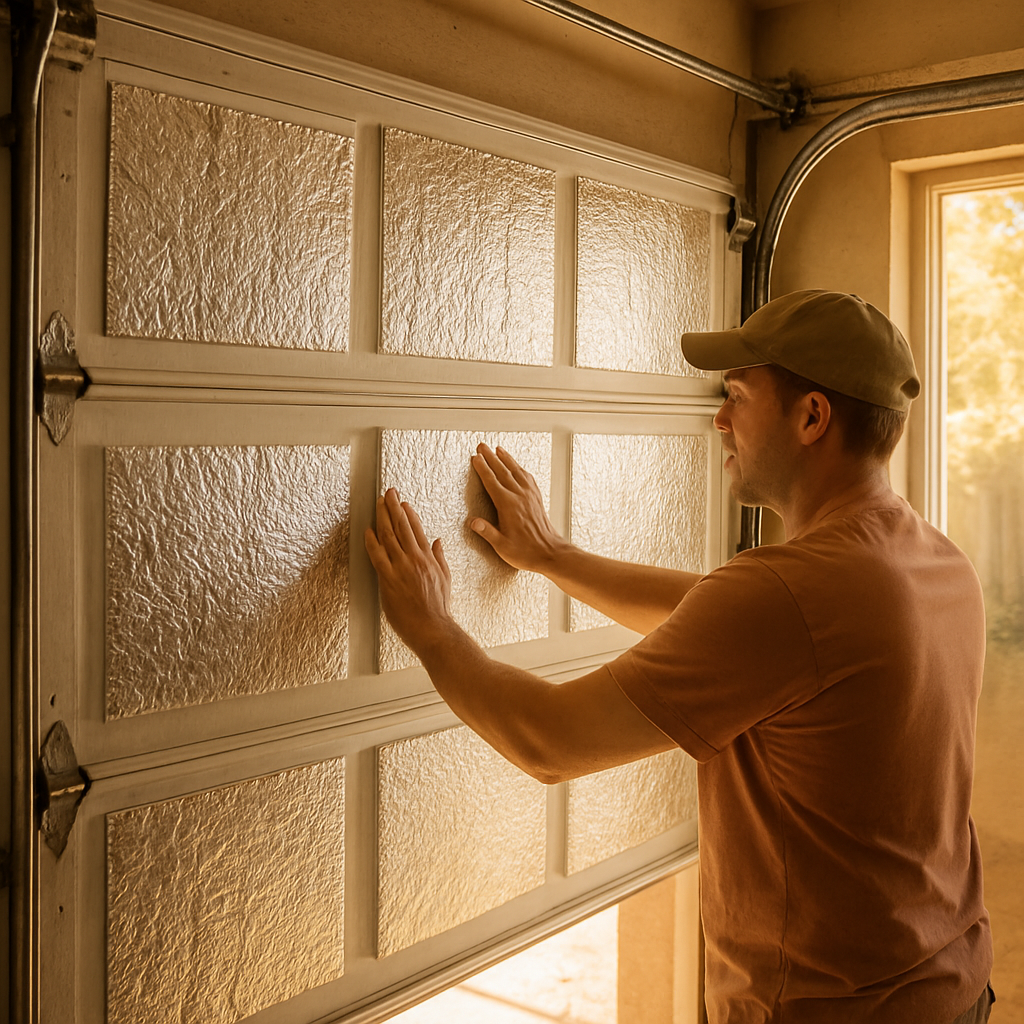
The Reach Barrier 3009 is the most tested and most recommended garage door insulation kit for hot climates. It uses a reflective radiant barrier with a bubble core, which addresses both radiant heat reflection and basic conductive insulation in one product.
- R-value: R-3 to R-5
- Radiant heat blocked: Up to 95%
- Coverage: One standard single garage door (9 x 7 or 8 x 7)
- Installation: Pre-cut panels with included tape — no tools required
- Price: $50-65
Users in Arizona and Texas consistently report 15-30°F temperature drops after installation. The adhesive is formulated for extreme heat and gets stronger rather than failing in high temperatures — a common failure point with cheaper kits. Available on Amazon.
2. NASA TECH White Reflective Foam Core Kit — Best R-Value for Hot Climates
If you want higher thermal resistance alongside radiant heat reflection, the NASA TECH kit steps up the performance with a thicker foam core and white reflective surface on both sides.
- R-value: R-8
- Radiant heat blocked: 95%
- Coverage: Single car garage door
- Installation: Cut to fit with included tape
- Price: $65-85
The R-8 rating makes this the top performer in its category for combined radiant and conductive insulation. The white finish also reflects more heat than the silver foil finish of competing products — a meaningful difference when the door faces direct afternoon sun. Find it on Amazon.
3. US Energy Products Nasatek 2-Car Kit — Best for Double Garage Doors
Standard single-car kits do not cover a double (16-foot) garage door. The Nasatek 2-car kit includes four 18-foot rolls specifically sized for double doors, plus a utility knife and squeegee for installation.
- R-value: R-8
- Radiant heat blocked: 90%
- Coverage: Two-car garage door up to 16 x 7
- Installation: Roll-and-tape method, slightly more involved
- Price: $95-120
If you have a double garage door and live in a hot climate, this is the only purpose-built solution that covers the full door without piecing together multiple single-car kits. Shop on Amazon.
4. SmartGARAGE Reflective Insulation Kit — Best for Extreme Heat (Arizona, Nevada, Texas)
SmartGARAGE is the most targeted solution for extreme hot climates. It uses a superior radiant barrier technology with heavy-duty all-weather adhesive specifically formulated for temperatures above 120°F — the kind of surface temperatures a metal garage door reaches in Arizona summer afternoons.
- R-value: R-8
- Radiant heat blocked: 95%
- Temperature reduction reported: Up to 30°F
- Coverage: 7 x 9 ft (standard single door)
- Price: $70-90
The adhesive on cheaper kits fails in extreme heat — panels peel and fall within months. SmartGARAGE’s adhesive is rated for desert heat and performs consistently through multiple summers. Available on Amazon.
5. Matador Rigid Foam Insulation Kit — Best Looking Finish
If appearance matters — you use the garage as a workshop or want a finished look — the Matador rigid foam kit snaps directly into standard garage door panel channels and gives a clean white factory-insulated appearance.
- R-value: R-4.8
- Installation: Snap-in panels, no adhesive required
- Best for: Attached garages used as living or work space
- Price: $80-110
The lower R-value makes this less optimal for pure heat blocking compared to the reflective kits, but the snap-in installation means panels will never peel or sag. For homeowners who use the garage daily and want it to look right, this is the best choice. Find it on Amazon.
Product Comparison: Hot Climate Garage Door Insulation

| Product | R-Value | Radiant Block | Best For | Price |
|---|---|---|---|---|
| Reach Barrier 3009 | R-3 to R-5 | 95% | Best overall hot climate | $50-65 |
| NASA TECH White Foam Core | R-8 | 95% | Best R-value | $65-85 |
| Nasatek 2-Car Kit | R-8 | 90% | Double garage doors | $95-120 |
| SmartGARAGE Kit | R-8 | 95% | Extreme heat climates | $70-90 |
| Matador Rigid Foam | R-4.8 | N/A | Clean finished look | $80-110 |
What R-Value Do You Need for a Hot Climate?
R-value requirements vary by how the garage connects to your home and how hot your climate gets:
| Situation | Recommended R-Value |
|---|---|
| Detached garage, mild heat (below 95°F) | R-3 to R-5 |
| Attached garage, moderate heat (95-105°F) | R-6 to R-8 |
| Attached garage, extreme heat (105°F+) | R-8 to R-13 |
| Garage used as living/work space | R-10 minimum |
For most hot climate homeowners with an attached garage, R-8 with a radiant barrier is the sweet spot. Going higher than R-10 with a retrofit kit is difficult without replacing the door entirely. If your situation requires R-13 or higher, a new insulated steel door with factory-injected polyurethane foam is the right solution rather than a retrofit kit.
Should You Insulate or Replace the Door?
A retrofit insulation kit costs $50-120 and takes 1-2 hours to install. A new insulated garage door costs $700-2,000 installed. Here is how to decide:
- Insulate your existing door if: The door is less than 15 years old, in good structural condition, and you want a cost-effective upgrade
- Replace the door if: It is old, damaged, or you need R-13+ for a garage used as living space. Factory-insulated doors with polyurethane foam reach R-18 to R-20 — impossible to achieve with a retrofit kit
For most homeowners in hot climates, a $65-90 insulation kit delivers 80% of the performance of a new insulated door at 5% of the cost. That is a strong return on a weekend project.
Installation Tips for Hot Climates
- Install early morning or late evening — adhesive applies better when the door surface is below 90°F. A door that has been baking in afternoon sun all day is too hot for reliable adhesive bonding.
- Clean the door surface thoroughly before applying tape. Dust, grease, and oxidation all reduce adhesion. Use isopropyl alcohol for best results.
- Check door balance after insulating — added weight can affect spring tension. Disconnect the opener, lift the door manually to waist height, and release. It should stay in place. If it falls, the springs need adjustment.
- Seal the perimeter too — insulating the door panels without sealing the gaps around the door leaves a major air and heat path. Replace weatherstripping if it is cracked or compressed. See our guide on fixing garage door leaks at the corners for the full seal-up process.
Related Guides
For our other buying guides, see Best Retractable Garage Screen Doors, Best Garage Door Opener With Battery Backup, Best Magnetic Garage Door Screen, Best Garage Door Hinges, Best Screw Drive Garage Door Opener, Best Lubricant for Garage Door Hinges, Best 1/2 HP Chain Drive Garage Door Opener, Best 3/4 HP Belt Drive Garage Door Opener, Best Garage Door Opener for Heavy Doors and Best Alexa-Enabled Garage Door Opener.
Frequently Asked Questions
Does garage door insulation actually keep heat out in summer?
Yes, particularly reflective radiant barrier insulation. Users in Texas and Arizona consistently report 15-30°F reductions in garage temperature after installing a quality reflective kit. The improvement is most noticeable in the afternoon when the door faces direct sun.
What is the best type of insulation for a garage door in Florida?
In Florida, humidity is as much of a concern as heat. Choose a closed-cell foam or reflective foil product — both resist moisture absorption. Avoid fiberglass batts, which absorb humidity and can support mold growth in Florida’s climate.
Will garage door insulation lower my energy bills?
For attached garages, yes. Heat entering the garage transfers through the shared wall into living spaces and adds to your cooling load. Insulating the garage door reduces this heat transfer and typically pays back the material cost within 2-3 summers through reduced AC bills.
Can I insulate a garage door myself?
Yes. All the kits on this list are DIY-friendly and require no special tools. Most homeowners complete a single-car door in 1-2 hours. The main steps are measuring, cutting panels to fit, cleaning the door surface, and applying panels with the included tape.
How long does garage door insulation last?
Quality reflective foam insulation lasts 5-10 years in hot climates. The limiting factor is usually the adhesive tape rather than the insulation material itself. Re-taping loose panels every few years extends the life significantly.
The Bottom Line
For most hot climate homeowners, the Reach Barrier 3009 is the best starting point — proven performance, easy installation, and a price that makes it a no-brainer. If you need higher thermal resistance or have a double door, step up to the NASA TECH R-8 kit or the Nasatek 2-car kit. Either way, insulating your garage door is one of the best-value summer upgrades you can make to your home.