
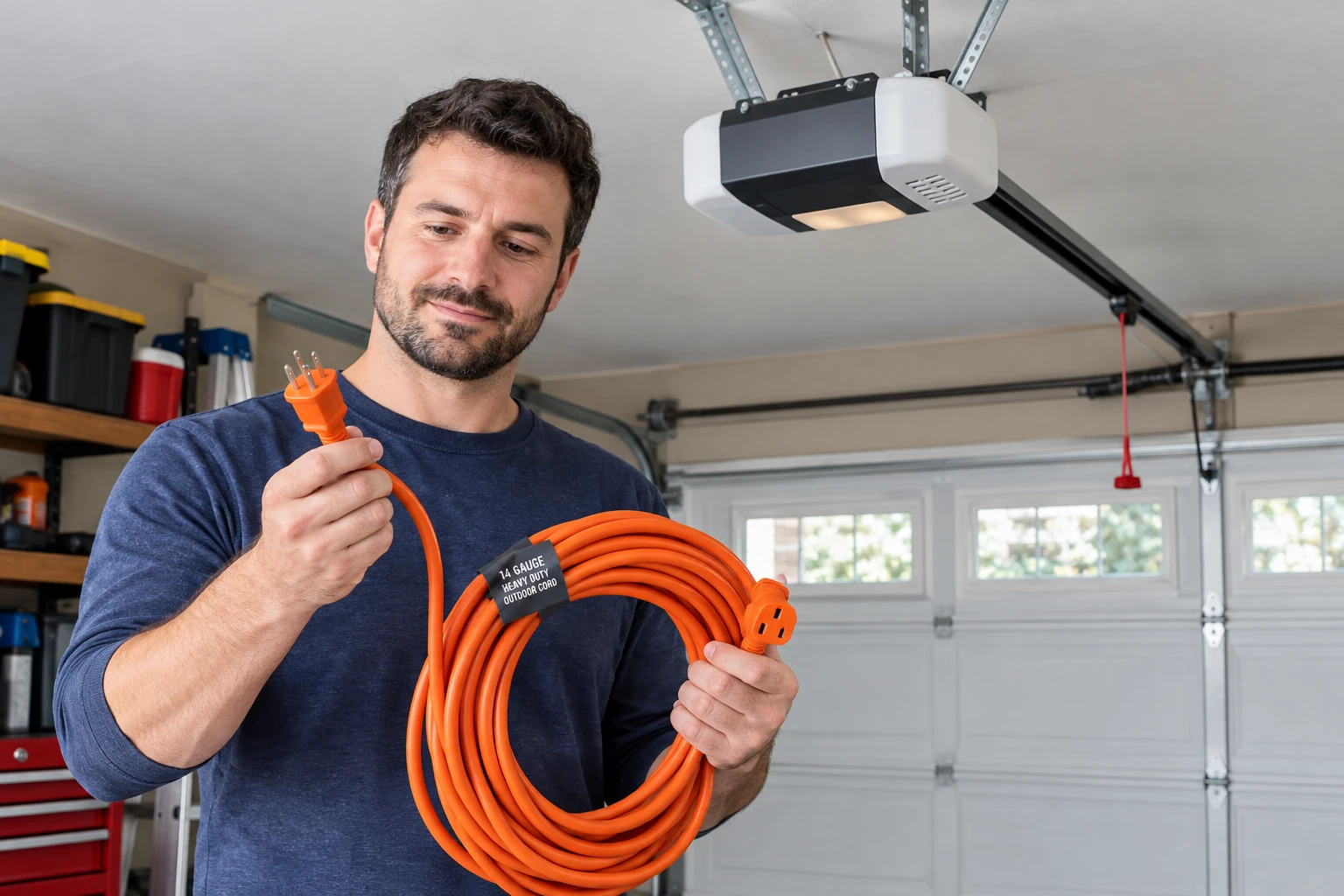
Your garage door opener’s factory cord is short — usually just 3 to 6 feet. If your outlet sits farther away, you’re stuck picking an extension cord, and picking the wrong one is a real fire risk. The right gauge extension cord for a garage door opener is a 14-gauge, three-prong, outdoor-rated cord no longer than 25 feet for most standard openers.
Get the gauge wrong and you’re not just risking a tripped breaker. Thin cords overheat under load, and an overheating cord tucked against drywall or wood framing is how garage fires start. Here’s exactly what to buy, what to avoid, and when to skip the extension cord altogether.
Short Answer
Short Answer: Use a 14-gauge extension cord for runs up to 25 feet, or 12-gauge for 25 to 50 feet. Most residential garage door openers draw 3 to 6 amps, and both gauges handle that load safely. Always pick a three-prong, grounded, outdoor-rated cord (SJTW) — never a thin indoor cord meant for lamps or holiday lights.
Extension Cord Gauge: What the Numbers Actually Mean
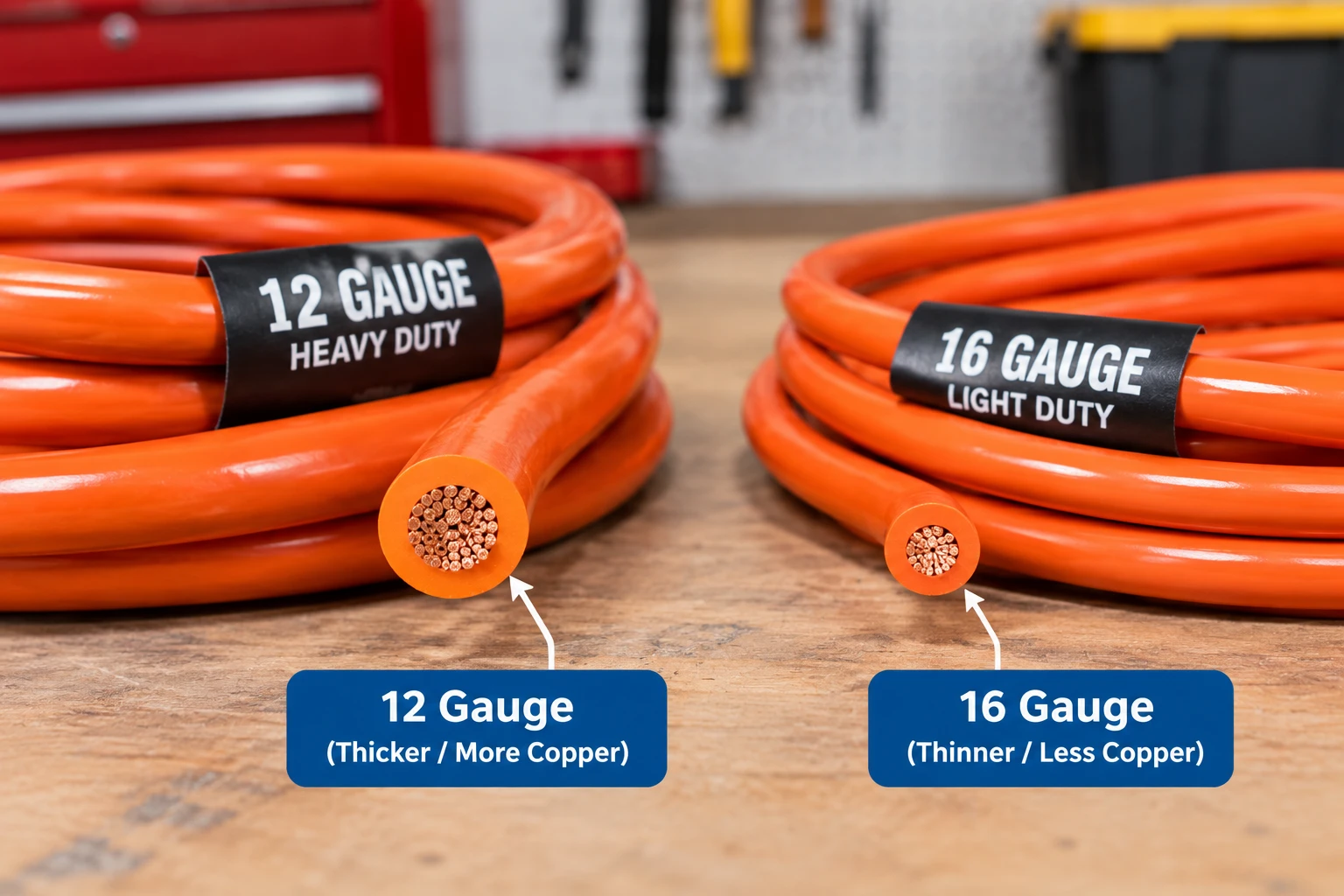
Gauge is a measurement of wire thickness, and it works backwards from what you’d expect. A lower gauge number means a thicker wire, and a thicker wire carries more current without overheating. A 12-gauge cord is thicker — and safer for higher loads — than a 16-gauge cord.
| Gauge | Wire Thickness | Typical Use |
|---|---|---|
| 10-gauge | Very thick | Large appliances, long runs |
| 12-gauge | Thick | Power tools, garage door openers (25–50 ft) |
| 14-gauge | Medium | Garage door openers (up to 25 ft), power tools |
| 16-gauge | Thin | Lamps, small electronics — not openers |
| 18-gauge | Very thin | Holiday lights, low-draw devices only |
A garage door opener needs steady current to run its motor and safety sensors without interruption. A cord that’s too thin for the amp draw causes voltage drop, and voltage drop makes the motor work harder than it should.
How Many Amps Does a Garage Door Opener Actually Draw?
Amp draw depends on motor horsepower. Here’s the realistic range for common residential openers, based on manufacturer specs across LiftMaster, Chamberlain, and Genie models:
| Motor Size | Running Amps | Startup Spike | Recommended Gauge |
|---|---|---|---|
| 1/2 HP | 3–4 amps | ~6 amps | 14-gauge (up to 25 ft) |
| 3/4 HP | 4.5–5 amps | ~8 amps | 14-gauge (up to 25 ft), 12-gauge beyond |
| 1 HP or larger | 5–6 amps | ~10 amps | 12-gauge, any length under 50 ft |
That startup spike matters more than most homeowners realize. The motor pulls its heaviest current for a split second when the door first starts moving — that’s the moment a marginal cord is most likely to overheat. Check your specific opener’s amp draw on the motor label before you buy a cord, since it’s printed right on the unit.
Recommended Cord by Distance
| Cord Length | Recommended Gauge | Suitable For |
|---|---|---|
| Up to 25 ft | 14-gauge | Standard 1/2–3/4 HP openers |
| 25–50 ft | 12-gauge | Heavier-duty or 1 HP+ openers |
| Over 50 ft | Not recommended | Install a dedicated outlet instead |
Rule of thumb: when you’re not sure which gauge to pick, go thicker. A 12-gauge cord costs a few dollars more than 14-gauge, and that’s cheap insurance against a failed motor or a scorched cord.
Safety Risk If You Use the Wrong Gauge
| Symptom | Likely Cause | Safety Risk Level | Fix |
|---|---|---|---|
| Cord feels warm or hot to the touch | Gauge too thin for the amp draw | High | Replace with 12-gauge immediately |
| Opener runs slower than usual, motor strains | Voltage drop from a thin or long cord | Medium | Switch to a shorter or thicker cord |
| Breaker trips during operation | Cord or circuit undersized for startup spike | Medium | Use 12-gauge or move to a dedicated circuit |
| Cord insulation cracked or discolored | Heat damage from prolonged overload | High | Stop use, replace cord, do not repair with tape |
This is a Safe for DIY task — buying and swapping an extension cord requires no electrical work. But if you notice a warm cord, a tripped breaker, or a burning smell, stop using it and unplug the opener. That’s a sign the setup needs a licensed electrician, not a thicker cord.
Why the Right Gauge Actually Matters
It Prevents Overheating
A thin cord — 16 or 18-gauge — can’t handle an opener’s current draw. The wire resists the flow of electricity, and that resistance turns into heat. Enough heat against wood framing or stored boxes is how garage fires start.
It Avoids Voltage Drop
Long or thin cords cause voltage drop, which forces the motor to work harder to do the same job. Over months of daily use, that extra strain shortens the motor’s lifespan and can trigger error codes on smart openers.
It Keeps You Code-Compliant — Mostly
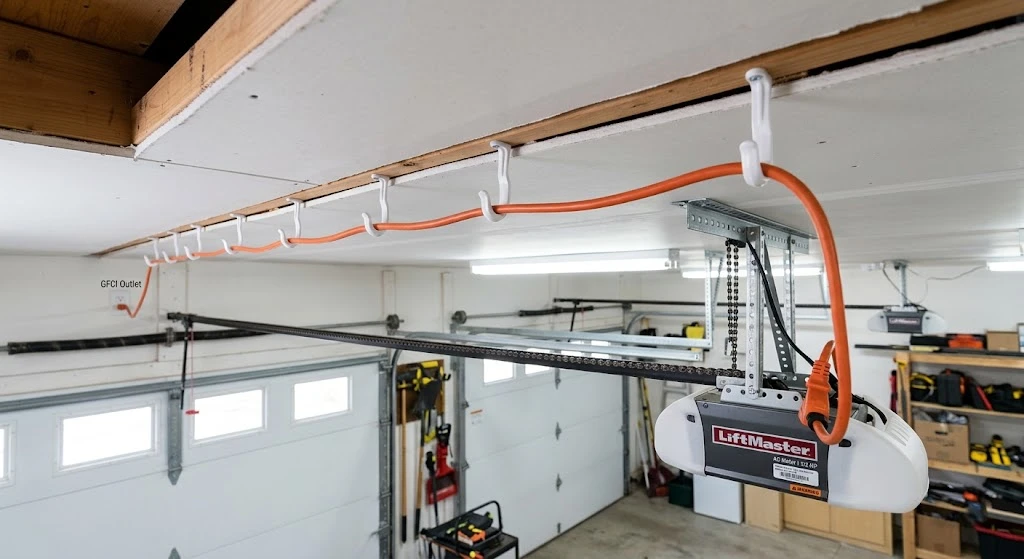
The National Electrical Code (NEC 400.8) prohibits using flexible cords, including extension cords, as a substitute for a structure’s fixed wiring. In plain terms: an extension cord is meant to be temporary. Stapling one to a joist or running it permanently behind drywall violates code, even if the gauge is correct.
If your opener’s outlet is more than 25–50 feet away, or if you’re setting up a permanent installation, the compliant fix is a dedicated outlet — not a longer extension cord.
What to Look for When Buying
- Three-prong, grounded plug — never use a two-prong or an adapter to force a grounded plug into a two-prong outlet
- Outdoor-rated insulation — look for SJTW or SJEOOW on the label, since garages see temperature swings and humidity indoor cords aren’t built for
- UL-listed certification — this confirms the cord passed independent safety testing
- The shortest length that reaches — don’t buy a 50-foot cord and coil the extra; coiled cord builds up heat faster than a straight run
A solid pick for most garages is a 12-gauge outdoor extension cord in the 25-foot range — thick enough for any residential opener and long enough for most garage layouts.
Real-World Cost Breakdown
| Option | Cost Range | Time |
|---|---|---|
| 14-gauge outdoor cord (25 ft) | $15–$25 | Immediate — plug and go |
| 12-gauge outdoor cord (25–50 ft) | $20–$40 | Immediate — plug and go |
| New dedicated outlet (electrician) | $150–$350 | 1–3 hours |
A cord is the cheap, fast fix. A dedicated outlet costs more upfront but removes the extension cord — and the NEC 400.8 gray area — entirely.
Example Scenario
Say your garage outlet sits 15 feet from the opener. A 14-gauge, 15-foot outdoor-rated cord handles that easily. Now say the outlet is 30 feet away — that’s past the safe range for 14-gauge, so upgrade to a 12-gauge cord to keep the voltage drop low and the cord cool.
Common Mistakes to Avoid
- Using a light-duty 16 or 18-gauge cord because it’s what was already in the garage
- Running the cord under a rug, under the garage door track, or through a doorjamb where it gets pinched
- Daisy-chaining two extension cords together to reach a farther outlet
- Cutting off or bypassing the grounded third prong
- Leaving a “temporary” cord stapled in place for years, which is exactly what NEC 400.8 is written to prevent
Each of these either creates a fire risk or turns a temporary fix into a permanent code violation.
FAQs About Extension Cord Gauge for Garage Door Openers
Can I use a regular household extension cord for my garage door opener?
It’s not recommended. Most household cords are 16 to 18-gauge, which is too thin for an opener’s amp draw. Use a 14-gauge or thicker, outdoor-rated cord instead.
What happens if I use the wrong gauge extension cord?
A cord that’s too thin causes voltage drop and overheating. Voltage drop makes the motor strain, and overheating can melt insulation or start a fire, especially in an enclosed garage.
Is it better to install a new outlet instead of using an extension cord?
For a permanent setup, yes. Electricians recommend adding a dedicated outlet near the opener. It costs more upfront but removes the fire risk and keeps you compliant with NEC 400.8, which treats extension cords as temporary wiring only.
Can I use an extension cord permanently for my garage door opener?
No. NEC 400.8 specifically prohibits using flexible cords as a substitute for a building’s fixed wiring. An extension cord is meant for short-term or temporary use, not as a permanent power solution.
This post contains affiliate links. If you buy through our links, we may earn a small commission at no extra cost to you. We only recommend products we’d use ourselves.