
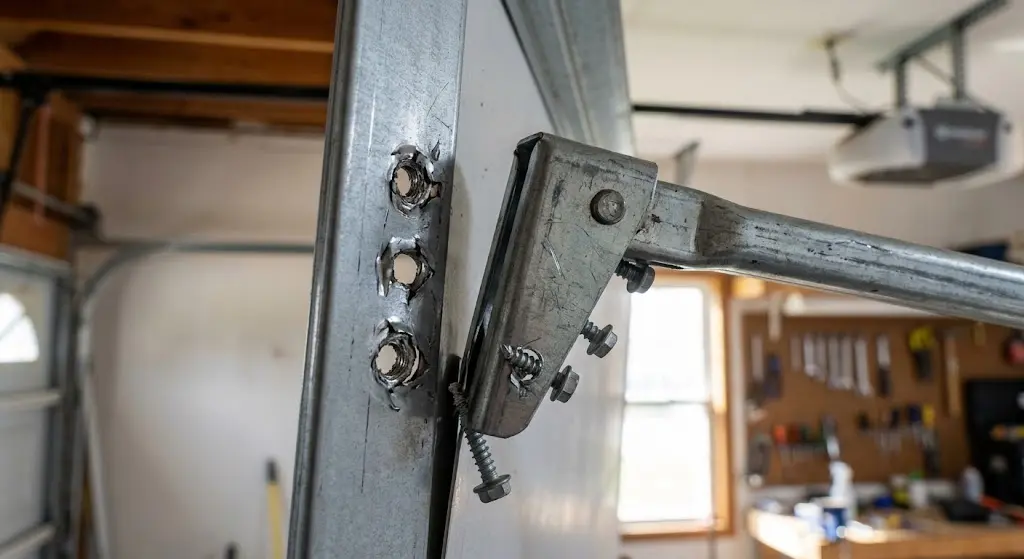
Garage door opener screws pulled out of the door usually means the bracket holding your opener’s drawbar has stripped the door panel it was mounted to. This is common on thin steel or aluminum doors, and it happens more often than most homeowners expect.
The good news: this is almost always a DIY fix. You just need larger screws, a reinforcement plate, or both — not a whole new door.
Short Answer: Garage door opener screws pull out when the door panel is too thin to hold repeated pulling force from the opener arm. Fix it by installing slightly larger self-tapping screws in fresh holes, or by adding a plywood or aluminum reinforcement plate behind the bracket to spread the load across a wider area.
This post contains affiliate links. If you buy through our links, we may earn a small commission at no extra cost to you. We only recommend products we’d use ourselves.
For a ready-made fix, a garage door opener reinforcement bracket kit spreads the load across a much wider section of the panel than the original screws ever did, and installs in about 30 minutes with basic hand tools.
Why Garage Door Opener Screws Pull Out
The opener’s drawbar bracket takes a hard pull every time the door opens and closes. On a full-size door, that’s thousands of cycles a year. Thin steel or aluminum panels, common on older or budget doors, simply don’t have enough material thickness to hold a screw under that repeated stress.
Three things make it worse. First, undersized screws — many openers ship with screws too small for the load. Second, misalignment — if the opener force setting is too high, it yanks harder than it should on every cycle. Third, age — screw holes widen slightly every time the door flexes, until one day the bracket simply lifts free.
| Field | Detail |
|---|---|
| Symptoms | Bracket hangs loose or falls off, door won’t open fully, grinding or popping sound near the top panel |
| Probable Causes | Undersized screws, thin door panel, opener force set too high, repeated stress over years |
| DIY Suitability | Safe for DIY |
| Safety Risk Level | Low to Medium — disconnect the opener before working on the bracket |
| Repair Cost Range | $5–$15 for screws, $15–$30 for a reinforcement bracket or plywood backer |
| Repair Time Estimate | 20–40 minutes |
Fix 1: Use Larger Self-Tapping Screws
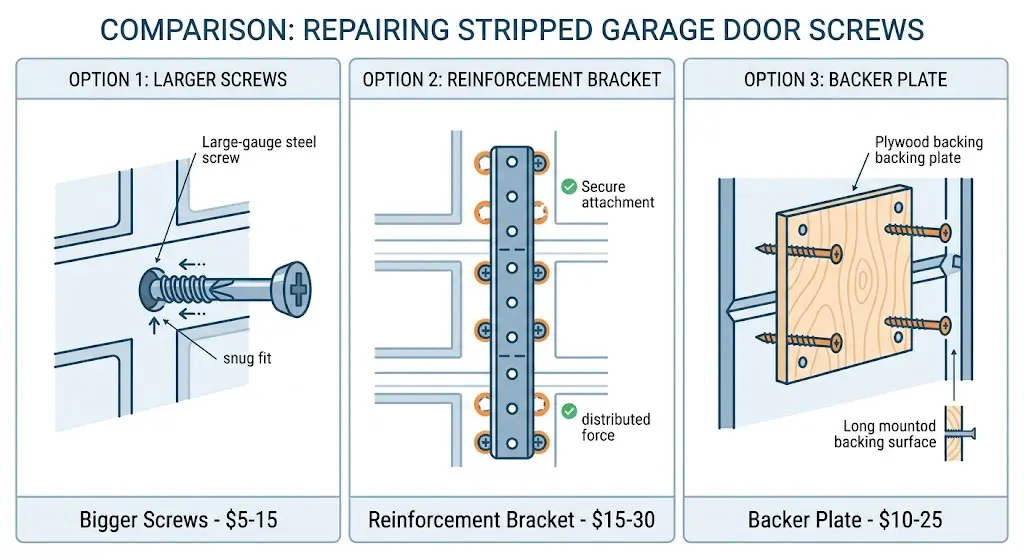
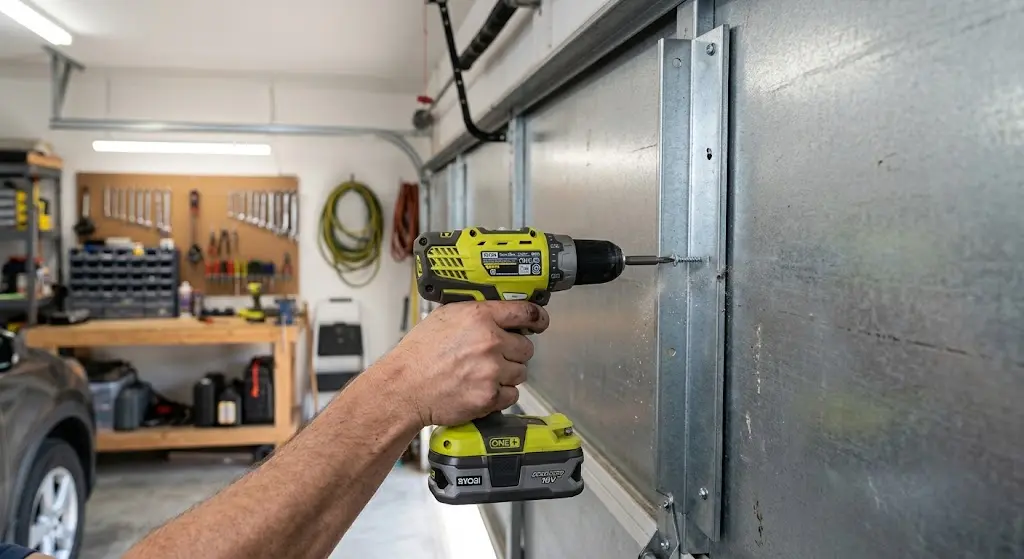
This is the fastest fix and works for most cases where the holes are only mildly stripped. Replace the old screws with self-tapping sheet metal screws one size larger in diameter. The larger screw bites into fresh material inside the same hole instead of relying on the worn-out threads.
Pull the drawbar bracket away from the door slightly so you can see the stripped holes clearly. Clean out any debris. Drive the new, larger screws in with a drill on a slow setting — going too fast can re-strip the hole before the threads catch. If the bracket has more than four mounting points, use all of them, even if the original installer skipped a couple.
Fix 2: Add a Reinforcement Bracket
If the screws keep pulling out even with larger hardware, the panel itself is too thin to hold any screw reliably. A reinforcement bracket spreads the pulling force across a much wider section of the door instead of concentrating it on four small holes.
Garage door reinforcement brackets are sold specifically for this job, usually 16 to 21 inches long, and mount vertically behind the drawbar bracket. Center it over the stripped holes, mark new screw locations along its full length, and drive screws through both the bracket and the door panel. The extra screw points along the bracket’s length do the real work of holding the load. If you would rather build one yourself, a 17 to 21 inch piece of 1/8-inch angle iron works as a low-cost substitute for a commercial reinforcement bracket — mount it the same way, using the existing hinge or strut screw at the top and bottom for extra hold.
Fix 3: Add a Plywood or Aluminum Backer Plate
For doors where even a reinforcement bracket doesn’t have enough solid material to bite into, a backer plate is the more permanent option. Cut a piece of ¾-inch plywood or 1/8-inch aluminum sheet slightly larger than the bracket. Mount it to the door with six to eight screws spread across its surface, then remount the opener bracket onto the plate instead of directly onto the door panel.
This spreads the opener’s pulling force over a much larger area, which is exactly what a thin door panel can’t do on its own. It takes longer than the other two fixes, but it’s the strongest solution for doors that have already failed once.
| Fix | Best For | Cost | Time |
|---|---|---|---|
| Larger self-tapping screws | First-time, mild stripping | $5–$15 | 20 minutes |
| Reinforcement bracket | Repeated pull-outs, thin panel | $15–$30 | 30 minutes |
| Plywood or aluminum backer plate | Panel already failed once, long-term fix | $10–$25 | 40 minutes |
Fix 4: Use a Rivet Nut (Nutsert) for a Permanent Repair
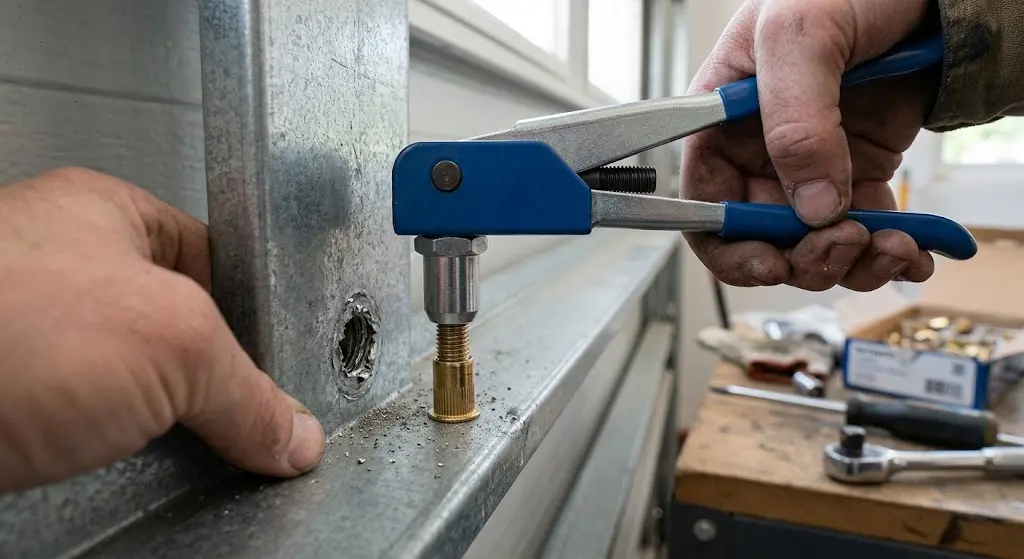
If the panel has some solid material left but the threads themselves are stripped beyond saving, a rivet nut — also called a nutsert — gives you a fresh, threaded hole without needing to reinforce the whole panel. It is a metal sleeve that expands and locks permanently inside the existing hole, creating solid threads a machine screw can grip indefinitely.
Drill the stripped hole out slightly to fit the nutsert size, insert it, and use a rivet nut tool (or a bolt and washers in a pinch) to expand and set it in place. Thread the bracket screw into the nutsert instead of directly into the door panel. This works well combined with Fix 2 or Fix 3 for a repair that will outlast the original installation.
Check the Opener Force Setting Too
If your screws keep pulling out even after reinforcing the bracket, check the opener’s force adjustment. Most openers have a force dial or setting inside the motor unit cover. A force setting that’s too high makes the opener pull harder than necessary on every cycle, which accelerates wear on any mounting hardware, no matter how strong.
Set the force to the lowest level that still lets the door open and close fully and reliably. Test a few cycles after adjusting. This one change can significantly extend the life of any bracket repair you just made.
When to Call a Professional
Most screw and bracket repairs are safe DIY jobs. Call a technician if the door panel itself is cracked, rusted through, or bent near the mounting area — reinforcing hardware won’t help if the surrounding material has failed. Also call a professional if you’re not comfortable working near the torsion spring, which sits close to the opener bracket on many doors and carries dangerous stored tension.
Frequently Asked Questions
Why do garage door opener screws keep pulling out?
The door panel is too thin to hold the repeated pulling force from the opener, especially if the original screws were undersized or the opener’s force setting is too high. Larger screws or a reinforcement bracket usually solves it permanently.
Can I just use bigger screws to fix stripped holes?
Yes, for mild stripping. A self-tapping screw one size larger than the original bites into fresh material in the same hole. If the holes are badly worn or the panel is thin, add a reinforcement bracket instead for a lasting fix.
What size screws does a garage door opener bracket need?
Most opener brackets use screws in the 3/4-inch to 1-inch range for door panels, though this varies by opener model. Check your opener’s installation manual for the exact size, and go one size larger if you’re replacing stripped screws.
Is a stripped garage door opener bracket dangerous?
It can become dangerous if left unrepaired. A bracket that fully detaches can let the door drop unexpectedly or damage the opener’s drawbar assembly. Fix it as soon as you notice looseness rather than waiting for a full failure.
Do I need to disconnect the opener before fixing the bracket?
Yes. Pull the emergency release cord to disconnect the trolley from the door before working on the bracket. This prevents the opener from trying to move the door while you’re working near the mounting point.
Related Guides
For more garage door opener troubleshooting, see our guides on garage door opener rail bending, garage door jerks when opening, and a garage door shifted to one side.
For official manufacturer guidance, see the Door and Access Systems Manufacturers Association (DASMA).