
The minimum ceiling height for a 10 ft garage door is 11 feet 3 inches with standard torsion spring hardware and a manual door. Add an automatic opener and you need at least 11 feet 6 inches. Get this wrong and your installer will turn up, measure the ceiling, and tell you the door will not fit. That conversation costs time and money. This guide gives you the exact numbers so you measure correctly before ordering anything.
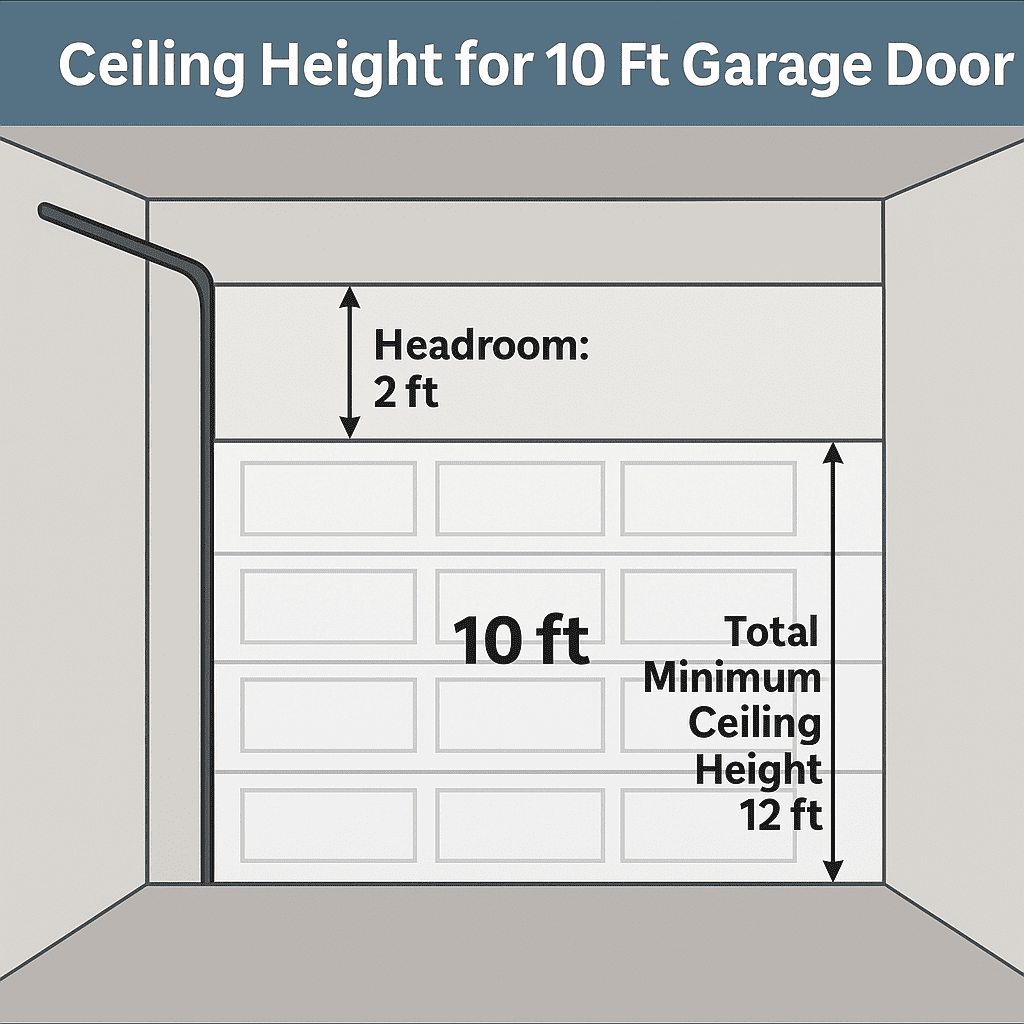
Short Answer: A 10-foot garage door needs a minimum ceiling height of 11 feet 3 inches for manual operation with torsion springs (12 inches of headroom above the door). For an automatic opener, you need 11 feet 6 inches (15 inches of headroom). If your ceiling is lower, a low-headroom track system can work with as little as 10 feet 4 inches of total ceiling height.

What Headroom Means and Why It Matters
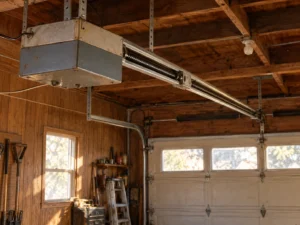
Headroom is the vertical distance between the top of your garage door opening (the header) and the ceiling directly above it. This space is where the horizontal track, torsion spring, and opener rail all live when the door is closed. If that space is too small, the hardware physically cannot fit and the door cannot open fully.
Most homeowners measure the door opening and assume the ceiling height only needs to match. It does not. A 10-foot door needs a ceiling significantly higher than 10 feet. The track curves up from the opening, the torsion spring bar sits above the door frame, and the opener rail extends several feet back toward the rear of the garage — all of this consumes headroom you must account for before ordering.
Exact Ceiling Height Requirements for a 10 Ft Garage Door
These numbers apply to standard sectional garage doors with torsion springs, which is the most common residential setup.
| Setup | Headroom Needed | Minimum Ceiling Height |
|---|---|---|
| Manual door, torsion spring, 12″ radius track | 12 inches | 11 ft 3 in (135″) |
| Automatic opener, torsion spring, 12″ radius track | 15 inches | 11 ft 6 in (138″) |
| Low-headroom track system, manual | 4.75 to 9 inches | 10 ft 5 in to 10 ft 10 in |
| Low-headroom track, with opener | 9 to 12 inches | 10 ft 10 in to 11 ft |
| Jackshaft wall-mounted opener | 4 to 6 inches | 10 ft 5 in minimum |
The 15-inch figure for automatic openers breaks down as: 12 inches for the torsion spring hardware and track radius, plus 3 inches for the opener trolley and rail bracket above the door. Garaga, one of the largest door manufacturers, specifies this exact split in their installation documentation.
How to Measure Your Headroom Correctly
Stand inside the garage. Hold a tape measure at the top edge of the door opening — the horizontal framing member above the door, called the header. Extend the tape straight up to the ceiling. That number is your headroom. Write it down before calling a dealer or ordering hardware.
Now check for obstructions. The headroom must be clear for the entire length of the door track, which runs from the front of the garage back toward the rear wall. Common obstructions that kill headroom include steel beams, HVAC ductwork, water pipes, recessed lighting, and dropped ceiling panels. Any one of these in the track path reduces your usable headroom — measure to the lowest obstruction, not the ceiling itself.
How to measure without a ladder
If you do not have a ladder tall enough: measure from the floor to the ceiling, then subtract 120 inches (10 feet, the door height). The result is your headroom. For example, a 135-inch floor-to-ceiling measurement minus 120 inches equals 15 inches of headroom — enough for a standard opener installation.
Track Radius and Why It Changes the Numbers
The curved section of track at the corner, where the door transitions from vertical to horizontal, is called the track radius. Standard residential track comes in three radii: 10 inches, 12 inches, and 15 inches. The 12-inch radius is the most common. A larger radius means a smoother transition and quieter operation, but it also requires more headroom.
| Track Radius | Headroom Required (manual) | Headroom Required (with opener) | Best For |
|---|---|---|---|
| 10-inch radius | 10 inches | 13 inches | Tight ceilings, lighter doors |
| 12-inch radius (standard) | 12 inches | 15 inches | Most residential garages |
| 15-inch radius | 15 inches | 18 inches | Heavier doors, smoother operation |
For a 10-foot door, which is heavier than a standard 7 or 8-foot door, a 12-inch or 15-inch radius track is recommended for smooth operation and longer spring life. Use a 10-inch radius only if headroom is genuinely tight and a standard track will not fit.

Backroom: The Other Measurement People Forget
Headroom gets all the attention, but backroom causes just as many installation surprises. Backroom is the horizontal depth of your garage from the front opening to the rear wall. When a sectional door opens, the panels travel up and back, lying flat against the ceiling. The door needs enough ceiling depth to lie fully open without blocking the rear of the garage.
The minimum backroom required is the door height plus 18 inches. For a 10-foot door: 120 inches plus 18 inches equals 138 inches, or 11 feet 6 inches of garage depth minimum. If your garage is shallower than that, the door panels will hang partially open and block the rear section of the garage. A car might fit in but a truck bed will not clear the hanging door.
| Door Height | Minimum Backroom | Recommended Backroom |
|---|---|---|
| 7 feet | 9 feet 6 inches | 11 feet |
| 8 feet | 10 feet 6 inches | 12 feet |
| 10 feet | 11 feet 6 inches | 13 feet |
| 12 feet | 13 feet 6 inches | 15 feet |
What to Do If Your Ceiling Is Too Low
If your ceiling height falls short of the standard 15-inch headroom requirement, you have three practical options before considering structural changes.
Option 1 — Low-headroom track system
Low-headroom track uses a double-channel design that allows the door panels to travel with less vertical clearance. The torsion spring can be repositioned to the back of the horizontal track rather than above the door frame, reducing headroom needs to as little as 4.75 inches for manual doors. Cost: $150 to $350 additional over a standard track system.
Option 2 — Jackshaft wall-mounted opener
A jackshaft opener (such as the LiftMaster 8500W) mounts on the wall beside the door rather than the ceiling. It drives the torsion bar directly, eliminating the ceiling rail entirely. This is the best option when you need a motor but have almost no headroom above the opening. Cost: $400 to $700 for the opener, compatible with most residential doors including 10-foot models.
Option 3 — Frame down the opening
If the ceiling cannot be raised and low-headroom hardware still does not give you enough clearance, the opening can be framed down — meaning the rough opening height is reduced by adding a header at a lower point. A 10-foot opening framed down to 9 feet allows for a 9-foot door with standard hardware. This requires a structural assessment and a permit in most US jurisdictions. Cost: $600 to $1,500 depending on the extent of the framing work.

Opener Compatibility With a 10 Ft Garage Door
Most standard residential garage door openers ship with a rail sized for 7 or 8-foot doors. A 10-foot door requires an extended rail — typically a 10-foot rail extension kit. Check before buying. LiftMaster, Chamberlain, and Genie all sell extension kits for $20 to $40 that convert a standard rail to fit taller doors.
A 10-foot garage door is also heavier than a standard residential door. For a door this size, a 3/4 HP or 1 HP motor is recommended. A 1/2 HP opener will work but will strain on a heavy insulated 10-foot door, shortening motor life. The LiftMaster 8365-267 (3/4 HP chain drive) and the Chamberlain B6765 (3/4 HP belt drive) are commonly specified for 10-foot door installations.
For related sizing guidance, see our comparison of 7 foot vs 8 foot garage door heights and how they affect ceiling requirements. If you are also considering door width, our guide on 16 vs 18 foot garage door widths covers the side clearance requirements in detail.
Related Guides
For our garage door sizing and dimension guides, see 8′ Garage Door Header Size Guide, How Heavy Is a Double Garage Door?, How Much Does a 16×7 Garage Door Weigh?, Garage Door 45 Degree Corners, What Size Header Do I Need for a 16 Foot Garage Door? and What Size Garage Door Opener Do You Need for 18 Foot Door?.
For official manufacturer guidance, see the Door and Access Systems Manufacturers Association (DASMA).
Frequently Asked Questions
What is the minimum ceiling height for a 10 foot garage door?
The minimum ceiling height for a 10-foot garage door is 11 feet 3 inches for a manual door with standard torsion spring hardware, and 11 feet 6 inches if you are adding an automatic opener. This gives the required 12 inches of headroom for the track and spring, plus 3 extra inches for the opener rail.
Can I install a 10 foot garage door if my ceiling is only 11 feet?
Possibly, with low-headroom hardware. An 11-foot ceiling gives you 12 inches of headroom above a 10-foot door. That is enough for a manual door with standard torsion springs but not quite enough for a standard automatic opener. A jackshaft wall-mounted opener eliminates the ceiling rail and solves this problem completely.
How much backroom does a 10 foot garage door need?
A 10-foot garage door requires a minimum of 11 feet 6 inches of garage depth from the opening to the rear wall. This allows the door panels to lie fully flat against the ceiling when open. We recommend 13 feet or more so the open door does not interfere with the rear of the garage.
Do I need a special opener for a 10 foot garage door?
Yes, you need an extended rail kit. Most openers ship sized for 7 or 8-foot doors. A 10-foot door requires a 10-foot rail extension, available from LiftMaster, Chamberlain, and Genie for $20 to $40. You also need at least a 3/4 HP motor for a door this size, especially if it is insulated.
What track radius should I use for a 10 foot garage door?
A 12-inch radius track is standard and works well for most 10-foot installations. A 15-inch radius offers smoother, quieter operation and is worth the extra headroom it requires for heavier insulated doors. Use a 10-inch radius only if ceiling height is critically tight.
What is the difference between headroom and backroom for a garage door?
Headroom is the vertical space above the door opening, needed for the track, spring, and opener hardware. Backroom is the horizontal depth of the garage, needed for the door panels to lie flat on the ceiling when fully open. Both must be measured before ordering a door. A 10-foot door needs 12 to 15 inches of headroom and at least 11 feet 6 inches of backroom.