
If your LiftMaster garage door opener is flashing error code 1-5, the door probably stopped mid-cycle, reversed unexpectedly, or won’t move at all. This code means the opener’s logic board lost track of the door’s movement during a cycle. A related sensor failure can also cause the LiftMaster 10 blinks error. The good news: most homeowners can fix this without calling a technician.
Error code 1-5 shows up as a blink pattern — one flash, pause, then five flashes — on the logic board LED or wall control panel. On MyQ-connected models, you might also see a “Motor Control Error” message in the app.
Short Answer: LiftMaster error code 1-5 means the logic board didn’t detect proper motor movement during a cycle, usually due to a disengaged trolley, binding door, or faulty travel module. Unplug the opener for 60 seconds, reconnect the trolley to the carriage, and check that the door moves freely by hand. If the door is heavy to lift manually, the problem is mechanical — not electrical — and needs spring or track repair first.
What Error Code 1-5 Actually Means
LiftMaster’s logic board constantly monitors the motor through a travel module, sometimes called the speed or RPM sensor. This module tells the board how fast the motor is spinning and whether the door is actually moving.
When the board commands the motor to run but doesn’t get the expected movement feedback, it throws error code 1-5 as a safety stop. The door either reversed on its own, moved a few inches and quit, or never moved at all.
This is different from error code 4-6, which points to safety sensor obstruction. With 1-5, the issue is mechanical or electrical — something with the door itself, the trolley, or the opener’s internal feedback system.
Power Reset: Your First Move
Before doing anything else, unplug the opener from its ceiling outlet. Wait a full 60 seconds — this lets the logic board’s capacitors fully discharge and clears temporary error states.
Plug it back in and wait for the LED lights to finish their startup sequence. Try the door again using the wall control button, not the remote, so you’re closer to watch what happens.
If the error code clears and the door cycles normally, you’re done. If error code 1-5 comes right back, move on to checking the trolley connection below.
| Symptom | Probable Cause | DIY Suitability | Safety Risk Level |
|---|---|---|---|
| Door reverses immediately after starting | Disengaged or loose trolley | Safe for DIY | Low |
| Motor runs but door doesn’t move | Trolley disconnected from carriage | Safe for DIY | Low |
| Door moves a few inches then stops | Binding track or worn rollers | Safe for DIY | Medium |
| Error returns after every reset | Faulty travel module or logic board | Professional required | Medium |
Check the Trolley Connection
The trolley is the small carriage that rides along the rail and pulls the door open through the arm. If it’s disengaged — which happens after a manual release or a power outage — the motor spins but the door stays put.
Look at the rail above the door. The trolley should be locked into the drive mechanism, with the emergency release cord hanging straight down, not at an angle. If the trolley is sitting in the wrong position, pull the release cord, manually slide the trolley back to reconnect with the drive carriage, then push the release lever back to the locked position.
Common mistake: homeowners pull the emergency release to move the door during a power outage, then forget to re-engage the trolley afterward. This alone causes a huge share of 1-5 errors.
Test the Door’s Manual Movement
With the trolley disconnected from the opener, try lifting the door by hand. A properly balanced garage door should lift smoothly with one hand and stay roughly in place when you let go halfway.
If the door feels heavy, drags, or drops on its own, you have a mechanical problem — likely a broken torsion spring, worn rollers, or a bent track. The opener’s motor isn’t strong enough to fight a poorly balanced door, and it will keep throwing error code 1-5 until the mechanical issue is fixed.
Safety warning: never attempt to adjust or replace a torsion spring yourself. These springs are under extreme tension and can cause serious injury. A professional spring replacement typically costs $150–$350, including parts and labor.
Inspect Wiring to the Travel Module
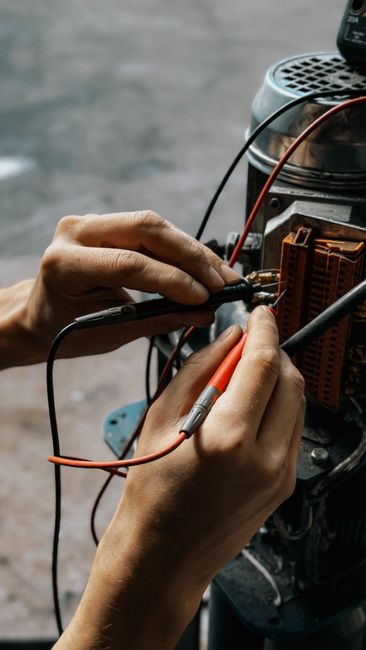
If the trolley is connected and the door moves freely by hand, the next suspect is the wiring between the motor and the travel module — the small sensor board that reports motor speed to the logic board.
Open the motor unit’s cover (unplug the opener first) and look for any loose, pinched, or corroded wire connections near the travel module. A loose connector here can cause intermittent 1-5 errors that seem to come and go randomly.
If you’re comfortable with basic electrical work, gently reseat any connectors you find. If wires look frayed or burnt, stop here — this points to a logic board issue that needs professional diagnosis.
| Repair | DIY Cost | Professional Cost | Time Estimate |
|---|---|---|---|
| Trolley reconnection | $0 | $75–$120 service call | 5–10 minutes |
| Roller replacement | $20–$40 (parts) | $100–$200 | 1–2 hours |
| Torsion spring replacement | Not recommended | $150–$350 | 1 hour |
| Logic board replacement | $60–$100 (parts) | $200–$350 | 1–2 hours |
Recalibrate the Travel Limits
If your opener doesn’t know exactly where “fully open” and “fully closed” are, it can stop mid-cycle and throw a 1-5 error. This often happens after a logic board reset or a new install that wasn’t fully programmed.
On most LiftMaster models with a 880LM or 828LM wall control, you’ll find a “Set Travel” or “Limit” menu in the settings. Follow the prompts to run the door through a full open-close cycle so the board can relearn the limits.
If your model uses dial-based limit adjustments on the motor unit itself, turn the limit screws in small increments — a quarter turn at a time — and test the door after each adjustment. Overcorrecting can cause the door to slam or stop too early.
When to Call a Professional
If you’ve reconnected the trolley, confirmed the door moves freely by hand, checked the wiring, and recalibrated the travel limits — and error code 1-5 still appears — the travel module or logic board itself is likely failing.
This is a $200–$350 repair in most cases, including the part and labor. Many LiftMaster models from the 8500W, 8550W, and 8355 series share compatible logic boards, so a technician can often source the part same-day.
If your opener is more than 10 years old and showing other signs of wear — like the remote not responding or the light not turning on — it may be more cost-effective to replace the whole unit. Our best garage door opener for heavy doors guide covers solid replacement options.
For wiring questions specific to your garage’s electrical setup, our guide on whether a garage door opener needs a dedicated circuit covers the NEC requirements every homeowner should know.
Frequently Asked Questions
Will unplugging my LiftMaster opener erase my remote programming?
No, a standard power reset (unplugging for 60 seconds) does not erase remote codes or MyQ settings. Those are stored in non-volatile memory. However, repeated hard resets triggered by a failing logic board can sometimes corrupt stored settings over time.
Can I drive my car if the garage door won’t open due to error code 1-5?
Yes. Pull the emergency release cord (the red handle hanging from the trolley) to disconnect the opener from the door. This lets you lift the door manually. Just remember to reconnect the trolley afterward, since a disengaged trolley is one of the most common causes of error code 1-5.
Is error code 1-5 the same on every LiftMaster model?
The blink pattern and meaning are consistent across most belt-drive and chain-drive LiftMaster models, including the 8500W, 8550W, and 8355 series. Wall-mount models may display the code differently on their digital panel, but the underlying motor-feedback issue is the same.
How long does it take to fix error code 1-5?
If the cause is a disengaged trolley or loose connection, fixing it takes 5 to 15 minutes. If the issue is mechanical — like a worn roller or unbalanced door — expect 1 to 2 hours for a DIY fix, or a same-day professional visit costing $100–$350 depending on the part needed.
Why does error code 1-5 keep coming back after I reset the opener?
A recurring 1-5 error after multiple resets usually points to a hardware problem rather than a one-time glitch — most often a failing travel module or logic board. If the door moves freely by hand and the trolley is properly engaged, it’s time to call a professional for diagnosis.
Related Guides
For other LiftMaster opener guides, see How Many Openers Can You Program to a LiftMaster?, LiftMaster Garage Door Won’t Close Without Holding Button, LiftMaster Keypad Programming With No Enter Button, LiftMaster Garage Light Won’t Turn On, LiftMaster 1/2 HP Troubleshooting, LiftMaster 1/3 HP Troubleshooting, LiftMaster 375UT Not Working and LiftMaster Error Code 42.
For official manufacturer guidance, see LiftMaster’s official support center.