

Your garage door keypad worked fine all fall, and now that temperatures dropped, it just won’t respond. You punch in the code, nothing happens, or the light doesn’t even blink. Cold weather is almost always the culprit, and it’s rarely the keypad itself that’s broken.
The most common cause is simple: cold saps voltage from batteries faster than any other single factor. A battery that reads “fine” at room temperature can drop below the keypad’s minimum working voltage once the mercury falls near freezing.
Below is every cause worth checking, in the order that actually fixes the problem fastest, plus how to stop this from happening every winter. In our experience, people replace the whole keypad far more often than they need to — the battery is the fix in the large majority of winter cases.
Short Answer: Garage door keypads stop working in cold weather mostly because low temperatures drop battery voltage below the keypad’s working threshold. Swap in fresh batteries — ideally lithium, not alkaline — and check the contacts for corrosion. If the keypad still won’t respond, the problem may be the opener’s receiver or a frozen sensor, not the keypad itself.
Why Cold Weather Kills Garage Door Keypad Response
Wireless keypads run on small alkaline batteries, and alkaline chemistry is exactly the kind that struggles in the cold. As temperature drops toward freezing, the chemical reaction inside the battery slows down and internal resistance climbs. The battery still holds charge — it just can’t deliver it fast enough for the keypad’s transmitter to send a clean signal.
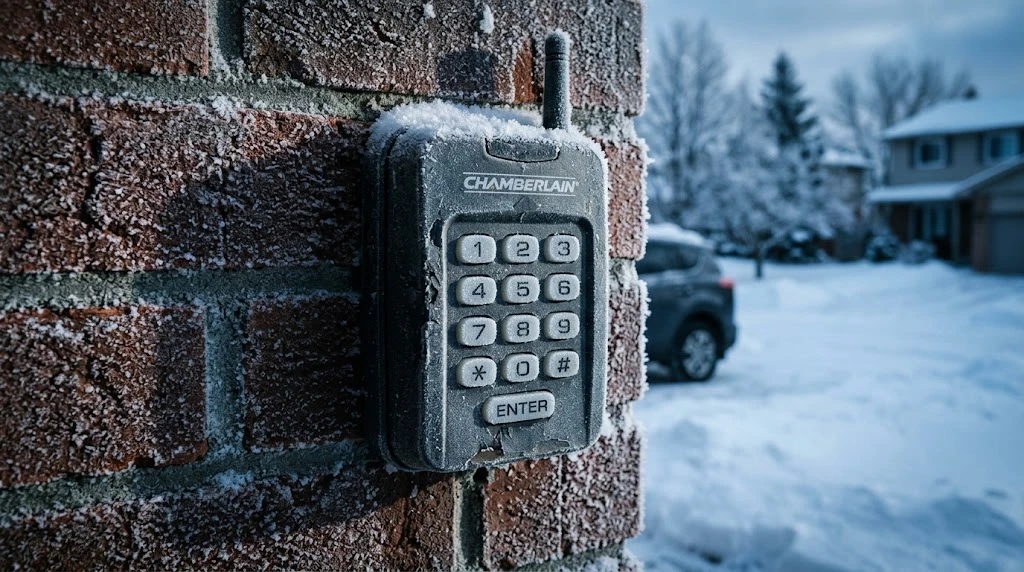
According to Energizer’s alkaline battery application manual, this voltage drop is a normal property of alkaline cells near 32°F, and performance returns once the battery warms back up to room temperature. That’s why a “dead” keypad in January sometimes works again if you bring the battery inside for an hour.
Wired keypads have a different weak point. They don’t rely on batteries, but the low-voltage wire connecting them to the opener can develop a poor connection at a wire nut or terminal, and cold makes brittle or corroded connections fail faster.
Quick Fixes to Try First
| Symptom | Probable Cause | DIY Suitability | Repair Time Estimate |
|---|---|---|---|
| No light, no response at all | Dead or weak battery | Safe for DIY | 5 minutes |
| Light blinks but door doesn’t move | Weak signal or low voltage | Safe for DIY | 10 minutes |
| Works intermittently in cold | Battery voltage sag, loose contacts | Safe for DIY | 10–15 minutes |
| Wired keypad totally unresponsive | Loose or corroded wire connection | Safe for DIY (check wiring) | 15–20 minutes |
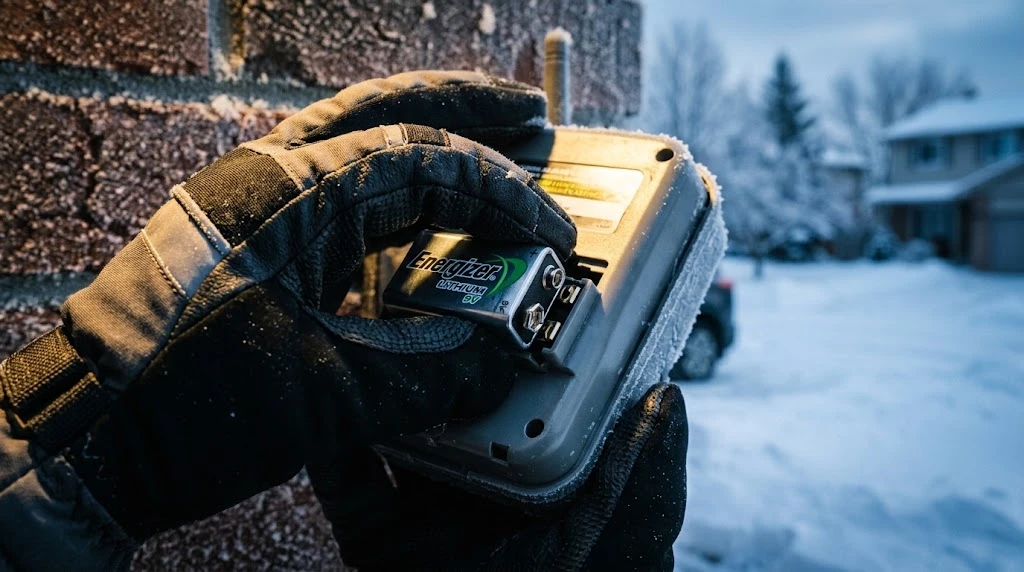
Start with a fresh battery, even if the old one isn’t fully dead. Wipe the battery contacts and the keypad’s terminals with a dry cloth first — moisture that froze and thawed leaves a thin film that blocks contact. If your keypad takes a 9-volt or coin cell, switch to a lithium version instead of alkaline; lithium chemistry holds voltage much better in the cold.
For wired keypads, check the connection at the opener’s control panel. A loose screw terminal is easy to miss and just as easy to fix — tighten it and test again before assuming the keypad itself failed.
Wireless vs. Wired Keypads — Cold Affects Them Differently
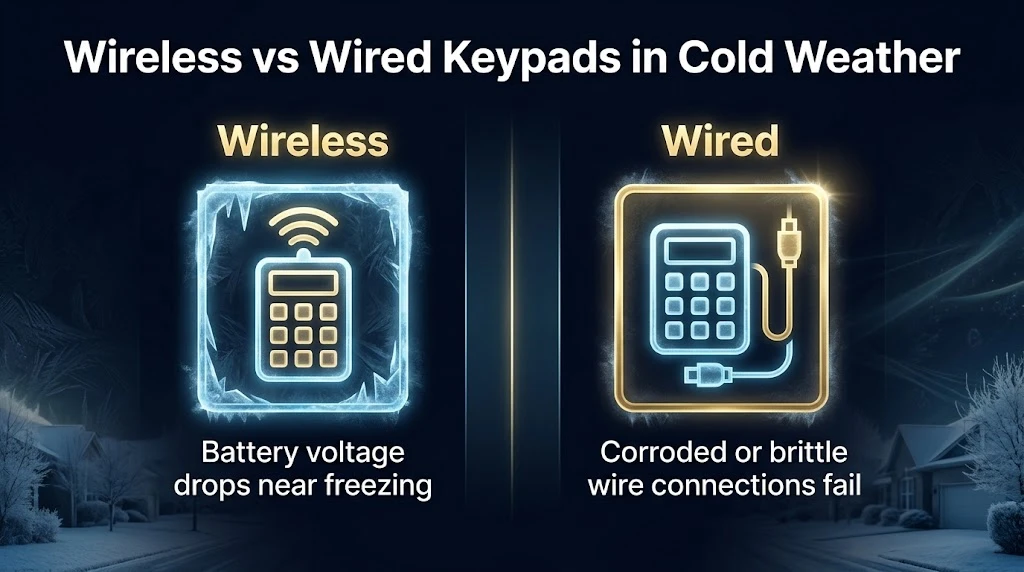
Wireless keypads are the most common type on newer installs from LiftMaster, Chamberlain, and Genie. They’re battery-powered and communicate with the opener over radio frequency, which means cold weather hits them at the battery level first, before anything else.
Wired keypads pull power directly from the opener’s low-voltage terminals, so batteries aren’t a factor. Instead, cold weather affects them through the wire itself — a hairline crack in old wiring, or corrosion at a splice, that only opens up once the wire contracts in freezing temperatures. If you’ve already reset a wireless keypad without success, our guide to resetting a Chamberlain keypad without the code walks through the process when you’re not sure what code is currently programmed.
If you’re unsure which type you have, check for a small battery door on the back. No battery door means it’s wired.
When It’s Actually the Opener or a Frozen Sensor, Not the Keypad
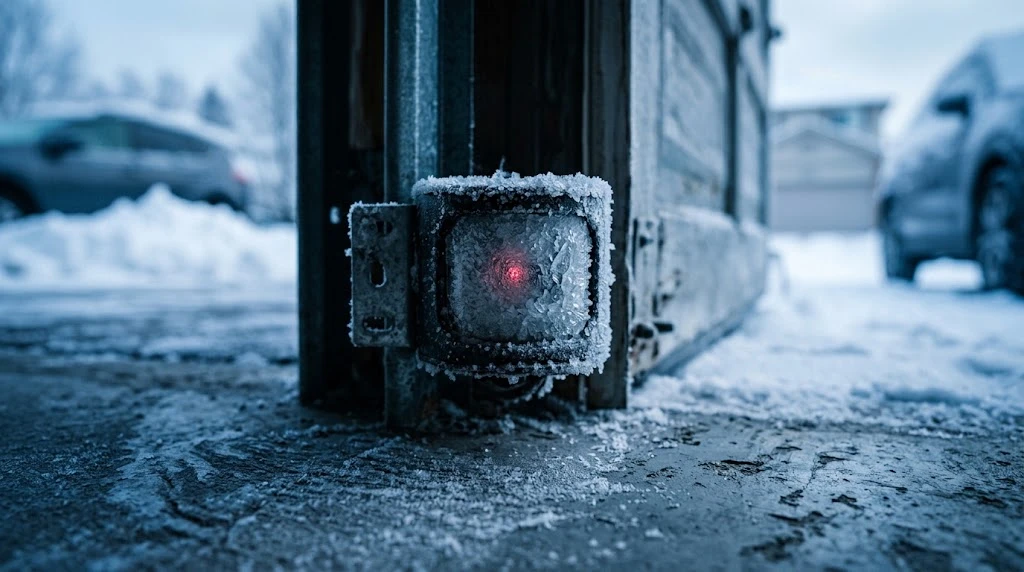
If you’ve replaced the battery and the keypad still doesn’t trigger the door, the keypad might be working fine while the opener isn’t receiving it. Cold garages can cause the opener’s antenna or receiver board to lose sensitivity, especially on older units.
Frozen safety sensors are a separate but related winter problem. If your sensor LEDs are blinking rather than steady, our guide to a garage door sensor blinking red covers what each blink pattern means. If moisture froze on the photo-eye lenses near the floor, the opener may refuse to close the door at all — a different symptom than a keypad that won’t open it. Test your remote control too. If the remote doesn’t work either, the problem is almost certainly the opener’s receiver, not the keypad — our guide to a remote that stops responding walks through isolating that.
Winterizing Your Keypad So This Doesn’t Happen Again
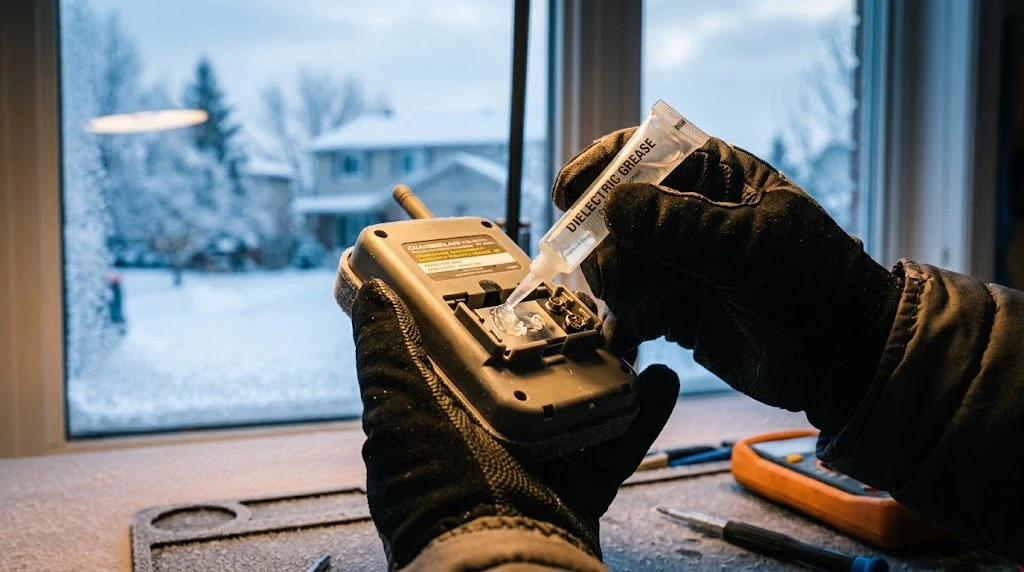
A few habits prevent most cold-weather keypad failures before they start. Swap to lithium batteries at the start of fall — they cost more but hold voltage down to roughly -40°F, well past what alkaline batteries can handle. Check the battery every season, not just when the keypad stops working, since a battery that’s already at 70% capacity has much less buffer left for a cold snap.
A thin layer of dielectric grease on the battery contacts blocks moisture from freezing against the metal. If your keypad mounts on an exterior wall with direct exposure to wind and precipitation, a small weatherproof cover extends its life significantly.
If you’ve got a LiftMaster keypad and the buttons themselves feel sluggish in the cold rather than unresponsive, that’s sometimes a programming quirk rather than a hardware issue — our guide on LiftMaster keypad programming without an Enter button covers models where the button layout causes confusion, cold weather or not.
When to Replace the Keypad
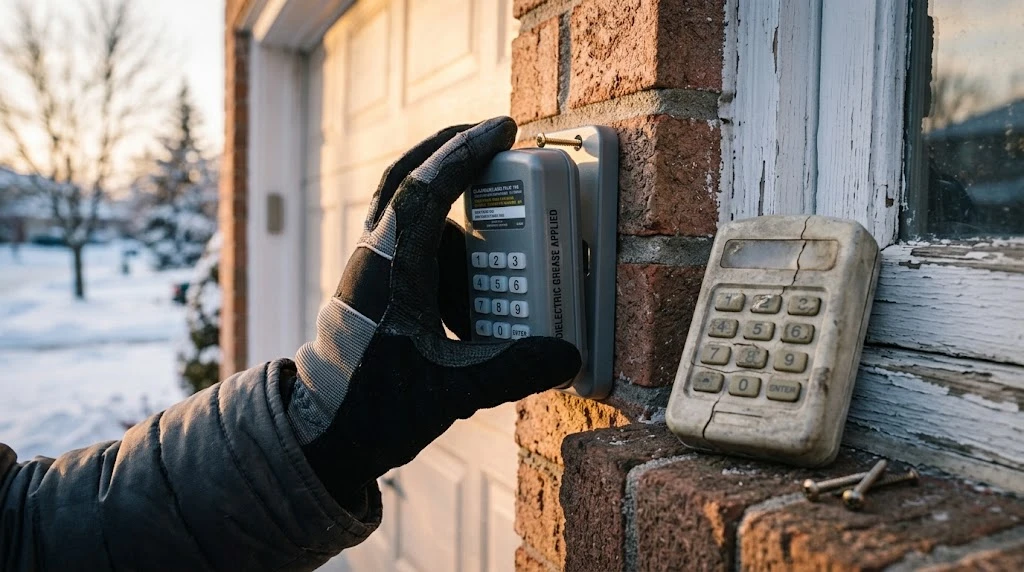
Most keypads last 5 to 10 years before the internal electronics themselves start failing, separate from battery issues. If you’ve tried a fresh battery, cleaned the contacts, and confirmed the opener responds to a remote, but the keypad still won’t transmit, the keypad’s circuit board may have failed.
Replacement keypads typically cost $20 to $50 and take about 15 minutes to program once installed. If you’re replacing an old keypad on a Craftsman opener, see our walkthrough on resetting a Craftsman keypad without an Enter button for the programming steps most new keypads follow.
Frequently Asked Questions
Why does my garage door keypad stop working when it’s cold outside?
Cold temperatures reduce the voltage output of standard alkaline batteries, which powers most wireless keypads. Even a battery that seemed fine in warm weather may not deliver enough voltage to transmit a signal once temperatures drop near freezing.
Will a new battery fix a garage door keypad that stopped working in winter?
In most cases, yes. A fresh battery — ideally lithium rather than alkaline — resolves the majority of cold-weather keypad failures. If a new battery doesn’t fix it, check the contacts for corrosion or moisture before assuming the keypad itself is broken.
Do lithium batteries really work better than alkaline in cold weather?
Yes. Lithium batteries maintain stable voltage output at much lower temperatures than alkaline batteries, which lose significant capacity as they approach freezing. For any device used outdoors in winter, lithium is the more reliable choice.
Can I bring my garage door keypad inside to warm it up?
If the keypad is a removable wireless unit, yes, and it often helps temporarily since a cold battery can regain some function once warmed. This isn’t a permanent fix, though — the same issue will return once it’s back in the cold with the same aging battery.
How do I know if it’s the keypad or the garage door opener that’s the problem?
Test your remote control. If the remote opens the door but the keypad doesn’t, the issue is isolated to the keypad or its battery. If neither the remote nor the keypad works, the opener’s receiver is the more likely culprit.
Related Guides
For our garage door electrical guides, see Does a Garage Door Opener Need a Dedicated Circuit? (NEC Rules), Problems with Garage Door Opener Extension Cord Explained, Why is my Garage Door Opener Tripping GFCI?, Garage Door Transformer Buzzing, Extra Lights Controlled by the Garage Door Opener, How Much Electricity Does a Garage Door Opener Use?, Genie Garage Door Opener Amp Draw and Best Surge Protector for Garage Door Opener.
For official manufacturer guidance, see the U.S. Consumer Product Safety Commission (CPSC).