
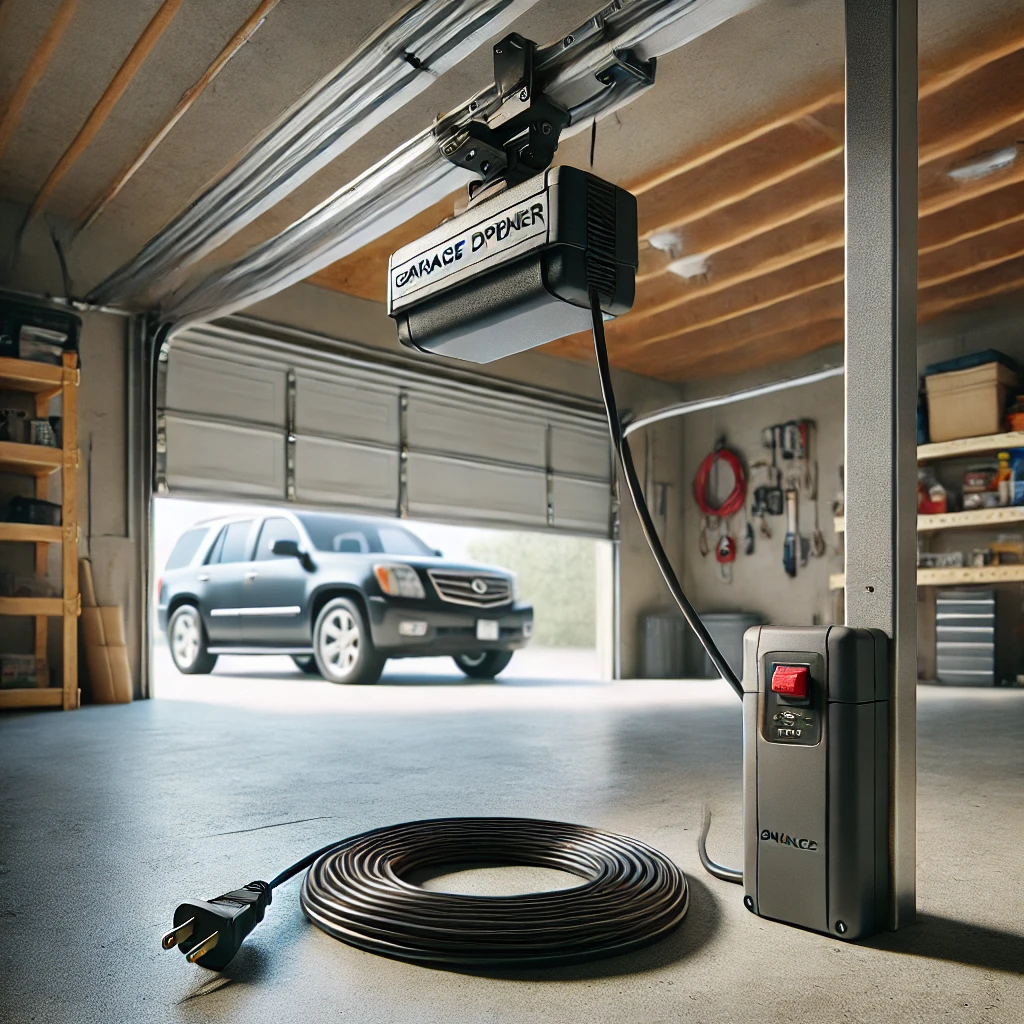
Using a garage door opener extension cord is not recommended as a permanent solution by any major manufacturer — LiftMaster, Chamberlain, and Genie all prohibit it in their installation manuals. But if the nearest outlet is too far away and a permanent circuit is not yet installed, you need to know which cord is safe to use temporarily and which will cause problems. This guide gives you the exact specifications.
Short Answer: If you must use an extension cord temporarily, use a 14-gauge or heavier (12-gauge) grounded three-prong cord no longer than 25 feet. Never use a 16-gauge or lighter cord, never use an ungrounded two-prong cord, and never use a cord rated below 15 amps. Long-term, run a permanent circuit — extension cords void most opener warranties and are a fire risk.

Why Manufacturers Prohibit Extension Cords
A garage door opener motor draws 4 to 7 amps running and spikes to 10 to 15 amps on startup. Extension cords add resistance to the circuit. Extra resistance means voltage drop — the motor receives less than the rated 120 volts, runs hotter, and works harder to lift the door. Over time, this shortens motor life significantly.
The larger risk is the cord itself. A cord that is too light for the load heats up at the startup surge and can melt insulation or ignite nearby materials. Garages contain combustible items — paint, gasoline, cardboard — that make a cord fire more dangerous than in other rooms. This is why LiftMaster’s installation instructions explicitly state that using an extension cord voids the warranty and creates a safety hazard.
If You Must Use a Cord: Exact Specifications
Sometimes a permanent outlet is not yet installed and you need the opener to work today. Use a cord that meets all of these requirements:
| Specification | Minimum Requirement | Recommended |
|---|---|---|
| Wire gauge | 14 AWG | 12 AWG for runs over 15 feet |
| Length | As short as possible | No longer than 25 feet |
| Amperage rating | 15 amps minimum | 20 amps preferred |
| Prongs | 3-prong grounded | 3-prong grounded |
| Cord type | Outdoor or heavy-duty rated | SJTW or SJTOW jacket |
The wire gauge number works in reverse — a lower number means thicker wire. A 12-gauge cord handles more current with less heat than a 14-gauge cord. Never use 16-gauge or lighter cords with a garage door opener. The standard orange or yellow light-duty cords sold in most hardware stores are 16-gauge and are not appropriate for this application.
How Cord Length Affects Performance
Voltage drop increases with cord length. A 14-gauge cord that is fine at 10 feet becomes a problem at 50 feet. Here is how to think about gauge versus length:
| Cord Length | Safe Minimum Gauge | Notes |
|---|---|---|
| Up to 10 feet | 16 AWG | Marginal — use only if 14 AWG unavailable |
| 10 to 25 feet | 14 AWG | Acceptable for temporary use |
| 25 to 50 feet | 12 AWG | Required to avoid voltage drop |
| Over 50 feet | Do not use | Run a permanent circuit instead |

Safety Rules to Follow With Any Extension Cord
- Never daisy-chain two cords together. Each connection point adds resistance and a potential failure point.
- Do not run the cord under a door, through a wall, or across a traffic area where it can get pinched or damaged.
- Keep the cord fully uncoiled when in use. A coiled cord acts as an inductor and generates heat at the startup surge.
- Never use a two-prong ungrounded cord. The opener motor chassis must be grounded to protect against shock.
- Do not use a cord with a damaged jacket, exposed wire, or loose plug. Discard it — repair tape on a power cord is not safe.
- The cord is a temporary measure only. Order a permit and run a permanent circuit as soon as possible.
The Right Permanent Fix: Run a Dedicated Outlet
NEC 210.52(G) requires at least one outlet in each attached garage. NEC 210.8(A)(2) requires it to be GFCI-protected. If your garage does not have an outlet near the opener, you need a new circuit — not a longer cord.
A licensed electrician can install a new 20-amp GFCI outlet near the opener in 2 to 3 hours. Cost: $150 to $350 depending on how far the new circuit runs from the panel. A building permit is required in most US jurisdictions. The outlet should be within 6 feet of the opener motor unit — close enough that the opener’s own power cord reaches without any extension at all.
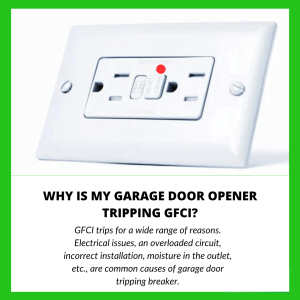
For the full NEC requirements and cost breakdown, see our guide on whether a garage door opener needs a dedicated circuit. If the opener is tripping a GFCI outlet after being connected, see our guide on garage door opener tripping GFCI for the correct diagnosis process.
Frequently Asked Questions
Can I use an extension cord permanently for a garage door opener?
No. LiftMaster, Chamberlain, and Genie all prohibit permanent extension cord use in their installation manuals, and it voids the opener warranty. Extension cords create voltage drop that shortens motor life and create a fire risk from the startup current surge. Run a permanent GFCI-protected outlet instead.
What gauge extension cord do I need for a garage door opener?
Use 14 AWG for runs up to 25 feet, and 12 AWG for runs up to 50 feet. Never use 16-gauge or lighter. The cord must be three-prong grounded and rated for at least 15 amps. For a 3/4 HP or 1 HP opener, use 12 AWG regardless of length.
Why does my garage door opener trip the breaker when on an extension cord?
The cord is adding resistance and causing voltage drop. The motor compensates by drawing more current, which exceeds the breaker or GFCI threshold. Use a heavier gauge cord (12 AWG), make the cord as short as possible, and ensure it is fully uncoiled. If the problem continues, run a permanent outlet.
Is it safe to use an extension cord with a LiftMaster opener?
LiftMaster explicitly prohibits permanent extension cord use and states it voids the warranty. For temporary use while awaiting a permanent outlet, a 12 or 14 AWG three-prong grounded cord under 25 feet is the minimum acceptable. Use a heavy-duty outdoor-rated cord, not a standard household extension cord.
How far can a garage door opener be from its outlet?
Most opener power cords are 6 to 8 feet long. The outlet should be within that distance of the motor unit, mounted on the ceiling. If the outlet is further away, the correct solution is to relocate the outlet or extend the permanent wiring — not to use an extension cord.
Related Guides
For our garage door electrical guides, see Garage Door Transformer Buzzing, Extra Lights Controlled by the Garage Door Opener, How Much Electricity Does a Garage Door Opener Use?, Genie Garage Door Opener Amp Draw, Garage Door Keypad Not Working in Cold Weather and Best Surge Protector for Garage Door Opener.
For official manufacturer guidance, see the U.S. Consumer Product Safety Commission (CPSC).