
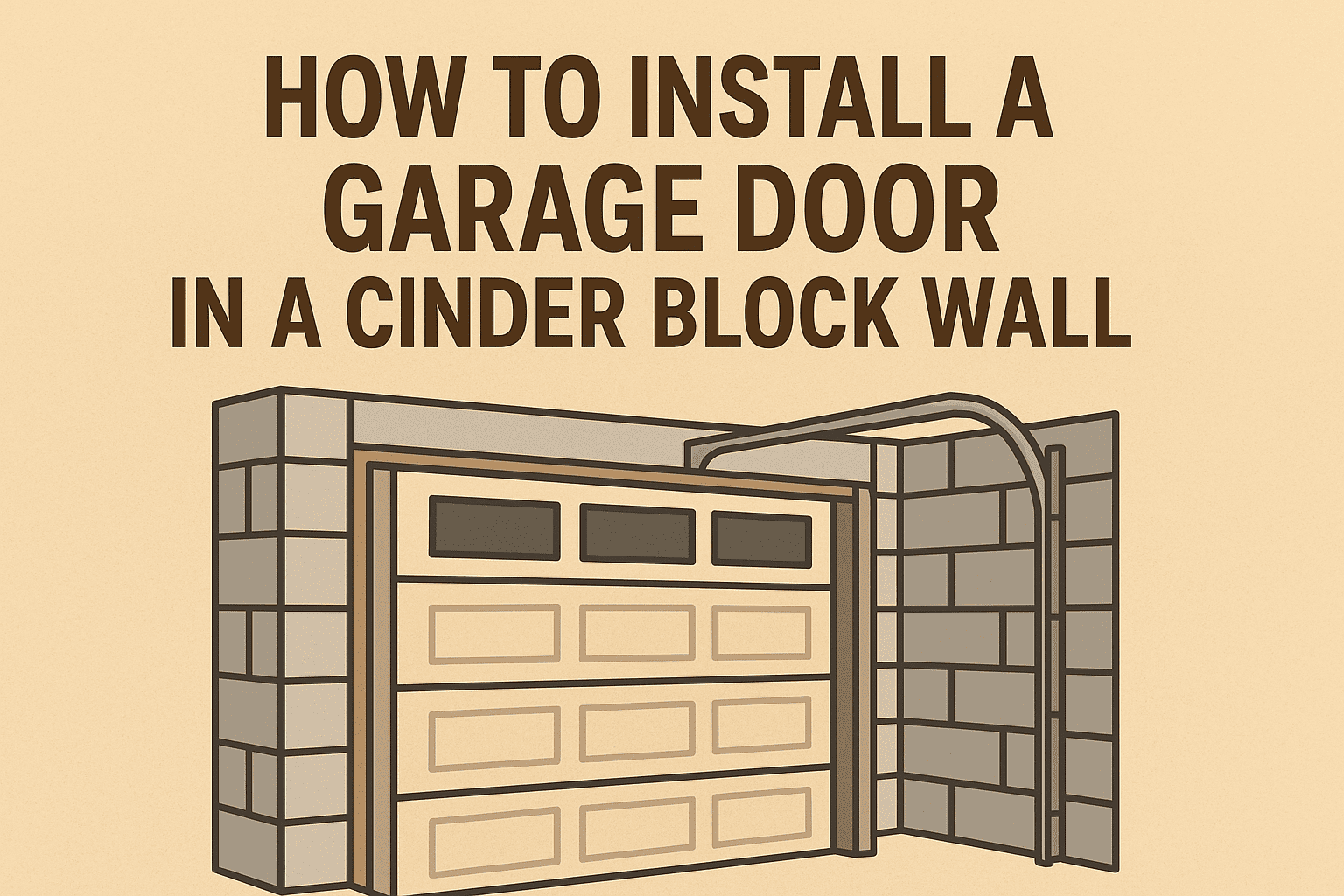
Installing a garage door in a cinder block wall requires a steel buck frame, masonry anchors, and careful header sizing — none of which a standard door installation covers. This guide walks through every step of the process with costs, tools, safety risks, and common mistakes to avoid.
Short Answer
Short Answer: Installing a garage door in a cinder block wall requires a steel buck frame bolted to the block with masonry anchors, since cinder block cannot hold fasteners under load on its own. You’ll also need a properly sized steel lintel above the opening to carry the wall’s weight. Most DIY installs take a full weekend, cost $890 to $1,980 in materials, and require a building permit since cinder block walls are almost always structural.
Why Cinder Block Installation Is Different
Want to add a garage door to your block wall? You’re not alone. Many homeowners upgrade their garages for easier access and a better look. Learning how to install a garage door in a cinder block wall can save you money and boost your home’s value.
Cinder block does not behave like wood framing. Standard fasteners pull straight out of hollow block under repeated stress — and a garage door cycles that stress every single time it opens and closes. The steps below account for the anchoring and load-bearing differences that matter most.

Permit and Safety Requirements
| Task | Safety Risk Level | DIY Suitability | Time Estimate |
|---|---|---|---|
| Cutting the block opening | Medium | Safe for DIY with proper PPE | 2–4 hours |
| Installing the steel buck frame | Low | Safe for DIY | 3–5 hours |
| Sizing and installing the lintel | High | Professional recommended for spans over 9 ft | 2–3 hours |
| Installing torsion springs | High | Professional recommended | 1–2 hours |
In most jurisdictions, cutting a new opening in a cinder block wall requires a building permit, since these walls are almost always load-bearing. Skipping the permit step can create problems later when you sell the home or file an insurance claim.
Tools and Materials You Will Need

- Steel buck frame (pre-welded or site-fabricated)
- Steel lintel or angle iron, sized to the opening (see below)
- Masonry anchors and lag bolts (3/8″ x 3-1/2″ minimum)
- Hammer drill with masonry bits
- Level (48″ recommended)
- Circular saw with a masonry blade, or angle grinder with a diamond blade
- Non-shrink grout for filling gaps around the frame
- Concrete screws or anchor bolts
- Standard garage door hardware kit
- Safety glasses, gloves, and a dust mask for cutting block
Step-by-Step Installation
Step 1: Verify or Cut the Opening Size
Measure the rough opening width and height carefully. Standard single garage doors require a rough opening 2 inches wider and 2 inches taller than the door size. A 9×7 door needs a 9’2″ x 7’2″ opening. You also need clearance on all sides: at least 4 inches on each side for standard 2-inch track hardware, 6 inches for 3-inch track, and a minimum of 12 inches of headroom above the finished opening.
If there’s no existing opening, score the cut lines on both sides of the wall with a circular saw and masonry blade, then break through the block with a sledgehammer, working carefully near the edges to avoid damaging the surrounding wall.
Step 2: Size and Install the Steel Lintel
The lintel is the beam that carries the weight of the block above the opening — this is the step homeowners most often underestimate. An undersized lintel leads to cracked mortar joints and a sagging wall over time.
A rough sizing example: for a 16-foot-wide opening in 8-inch CMU block with 4 feet of wall above it, the load works out to roughly 220 pounds per linear foot on the lintel. That load typically calls for a steel angle in the 6x6x3/8″ range, or a reinforced concrete bond beam. The lintel needs to extend at least 8 to 12 inches into the masonry on each side of the opening for proper bearing.
These numbers are a starting point, not a substitute for engineering. For spans wider than 9 to 10 feet, or any opening supporting a floor or roof load above it, have a structural engineer confirm the lintel size before you cut into the wall.
Step 3: Install the Steel Buck Frame
A steel buck frame is essential in cinder block walls. Unlike wood framing, cinder block does not hold fasteners reliably without a solid anchor point. The buck frame sits inside the opening and provides the attachment surface for the door jambs and hardware.
- Set the buck frame in the opening and check it is plumb and level on all sides.
- Mark anchor bolt locations every 16 inches along each side and the header.
- Use a hammer drill to bore 3-1/2″ deep holes into the block at each mark.
- Insert masonry anchors and secure the frame with 3/8″ lag bolts.
- Fill gaps between the frame and block with non-shrink grout. Allow it to cure 24 hours before loading the frame.
Step 4: Install the Door Sections
With the buck frame secured, door installation proceeds the same as any standard garage door. Attach the bottom section first, install the tracks on each side, then stack each panel upward. Check that tracks are plumb before tightening hardware permanently. The header clearance above the door needs at least 10 to 12 inches for standard track hardware.
Step 5: Install Springs and Cables
Torsion springs mount on a steel tube above the door, anchored to the wall above the header. In a cinder block wall, the spring anchor bracket must be bolted to either the steel buck frame or a steel angle iron lagged into the block — never directly into drywall or furring strips. Extension springs on older door systems attach to the tracks and require safety cables threaded through them to prevent injury if a spring breaks.
Spring tension is dangerous. If you haven’t worked with torsion springs before, this is the one step worth paying a professional for, even on an otherwise DIY project.
Common Mistakes to Avoid
- Using wood nailers without steel backing — cinder block is hollow and does not hold nails or screws under load
- Skipping the buck frame — attaching door jambs directly to block causes loosening over time
- Undersizing the lintel — this causes cracked mortar joints and wall sag months or years later
- Not accounting for headroom — check ceiling height requirements before ordering hardware
- Forgetting weatherstripping — the gap between the steel frame and block needs foam backer rod and caulk to prevent air and water infiltration
Cost Breakdown
| Item | Cost Range |
|---|---|
| Steel buck frame (fabricated) | $200–$400 |
| Steel lintel or angle iron | $100–$300 |
| Garage door (9×7 standard) | $500–$1,200 |
| Hardware kit (springs, tracks) | $150–$300 |
| Masonry anchors and fasteners | $40–$80 |
| Professional installation labor | $300–$600 |
| Total (DIY) | $990–$2,280 |
| Total (Professional) | $1,290–$2,880 |
Related Guides
For our installation and framing guides, see How to Reinforce a Garage Door for an Opener, Garage Door 45 Degree Corners, Garage Door in a Grain Bin, What Size Header Do I Need for a 16 Foot Garage Door?, Carpenters Blocks Garage Door, Will a Doorbell Button Work for a Garage Door Opener?, False Wall Behind a Garage Door, Replacing a Garage Door With a Sliding Glass Door, and False Wall in Front of a Garage Door.
Frequently Asked Questions
Do I need a permit to install a garage door in a cinder block wall?
In most jurisdictions, yes. Any structural opening in a load-bearing wall requires a permit. Cinder block walls are almost always structural. Check with your local building department before starting work.
Can I use a wood frame instead of a steel buck?
Not recommended. Cinder block does not hold wood fasteners reliably under the repeated loading of a garage door. A steel buck frame is the correct solution and will last the life of the building.
How do I reinforce a block wall for a garage door?
Use a steel lintel or reinforced concrete header to carry the weight above the door opening, and anchor the spring bracket to the steel buck frame or a lagged steel angle iron rather than directly into the block.
How do I size the steel lintel for a garage door opening?
Multiply the wall height above the opening by the block’s weight per square foot, then by the opening width, to estimate the total load. For openings wider than 9 to 10 feet, or any wall carrying a floor or roof load, have a structural engineer confirm the lintel size before cutting the wall.
How much clearance do I need around a garage door in a block wall?
Plan for at least 4 inches of side clearance for standard 2-inch track hardware, 6 inches for 3-inch track, and a minimum of 12 inches of headroom above the finished opening for the torsion spring and track hardware.