
Your LiftMaster 1/2 HP garage door opener has stopped working — or it’s acting up in ways that make no sense. Before you call a technician or order a replacement, work through this guide. The most common problems with LiftMaster 1/2 HP models are fixable in under 30 minutes with no special tools.
LiftMaster’s 1/2 HP lineup includes the popular 8360W, 8355, 3255, and 3280 models. These are chain and belt drive openers designed for standard single and double garage doors. They’re reliable machines — but every opener develops problems eventually, and knowing what to look for saves you time and money.
LiftMaster 1/2 HP Troubleshooting: What’s Wrong?
Short Answer: The most common LiftMaster 1/2 HP problems are: door won’t open or close (sensor or limit switch issue), remote not working (dead battery or lost programming), opener runs but door doesn’t move (trolley disconnect or broken spring), and error codes on the display. Most issues are DIY-fixable. A broken torsion spring always requires a professional.
Quick Symptom Guide
| Symptom | Most Likely Cause | DIY Fix? |
|---|---|---|
| Won’t respond to remote or wall button | Power issue, blown fuse, or logic board | Yes — check power first |
| Motor runs but door doesn’t move | Trolley disconnect or broken spring | Partial — spring requires pro |
| Door opens but won’t close | Safety sensor misalignment or blockage | Yes |
| Door closes but immediately reverses | Close limit set too far, sensor issue | Yes — adjust limit screws |
| Remote stopped working | Dead battery, lost programming, RF interference | Yes |
| Opener makes grinding noise | Worn chain/belt, loose trolley, bad gear | Partial |
| Error code on display | Specific fault — read code | Depends on code |
| Light won’t turn on | Bulb, LED interference, or socket fault | Yes |
Full Diagnosis Table
| Field | Detail |
|---|---|
| Symptoms | Varies by fault — see symptom guide above |
| Probable Causes | Power loss, sensor fault, limit switch, broken spring, logic board, remote programming |
| DIY Suitability | Most problems: Yes. Broken torsion spring: Professional required |
| Safety Risk Level | Low to High — torsion springs are High risk |
| Repair Cost Range | $0 (settings) to $200+ (spring replacement with labor) |
| Repair Time Estimate | 5 minutes (remote reprogramming) to 2 hours (gear replacement) |
Problem 1: Opener Won’t Respond at All
If pressing the remote or wall button does nothing — no motor sound, no light, no reaction — start with power.
- Check the outlet your opener plugs into. Plug in a lamp or phone charger to confirm the outlet has power. Many garage outlets are on a GFCI circuit — look for a tripped GFCI outlet on the garage wall and press the reset button.
- Check your home’s breaker panel for a tripped breaker labeled “garage.”
- Look for a fuse on the motor unit itself. Some LiftMaster 1/2 HP models have a small automotive-style fuse (usually 3A or 5A) near the terminal strip on the back of the motor head. A blown fuse causes total silence.
- If power is confirmed and the opener still doesn’t respond, the logic board may have failed. This requires replacement.
Problem 2: Motor Runs But Door Doesn’t Move
You hear the motor, but the door stays put. This almost always means one of two things.
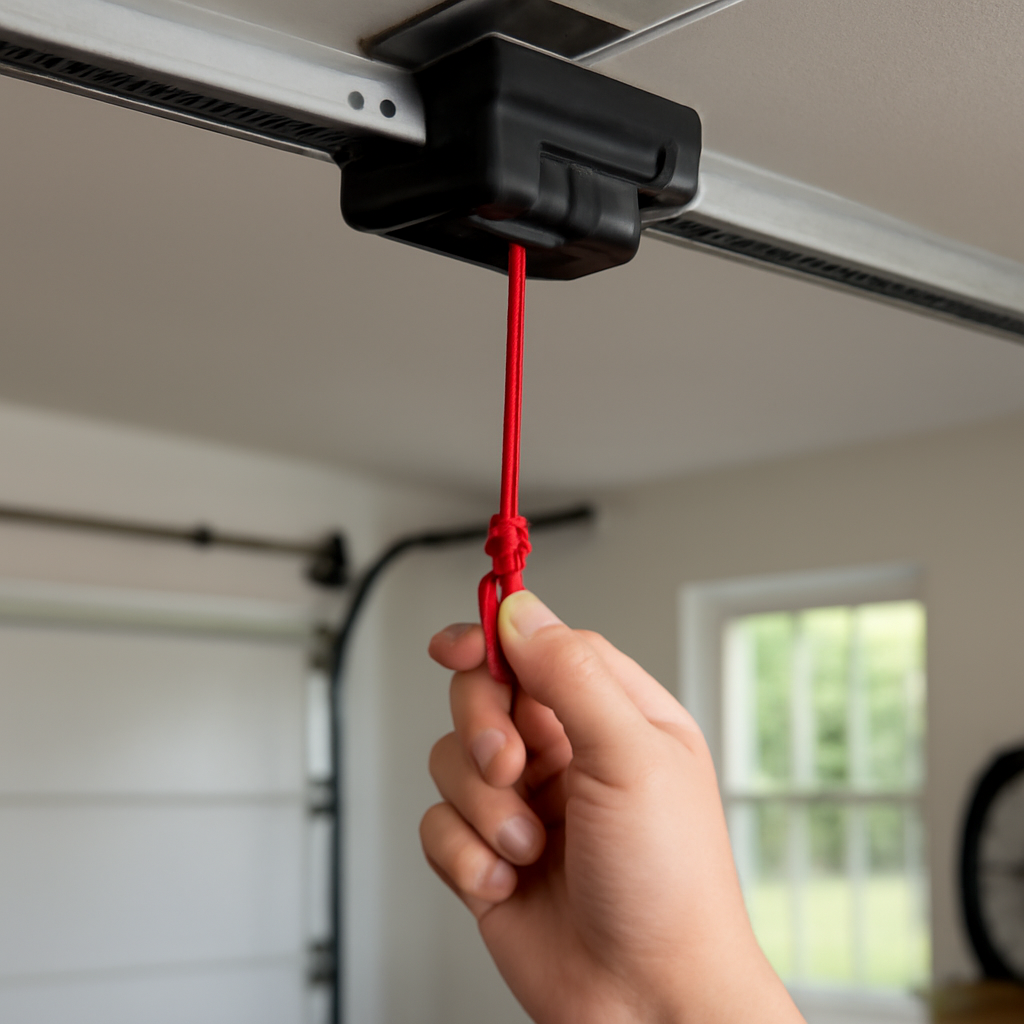
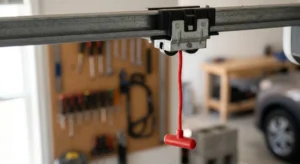
Trolley disconnect: Every LiftMaster opener has a red emergency release cord hanging from the trolley (the carriage that rides the rail). If this cord was pulled — intentionally or accidentally — the door disconnects from the drive and operates manually. To reconnect, pull the red cord toward the motor unit (not straight down), then manually move the door until the trolley re-engages with a click. Test with the wall button.
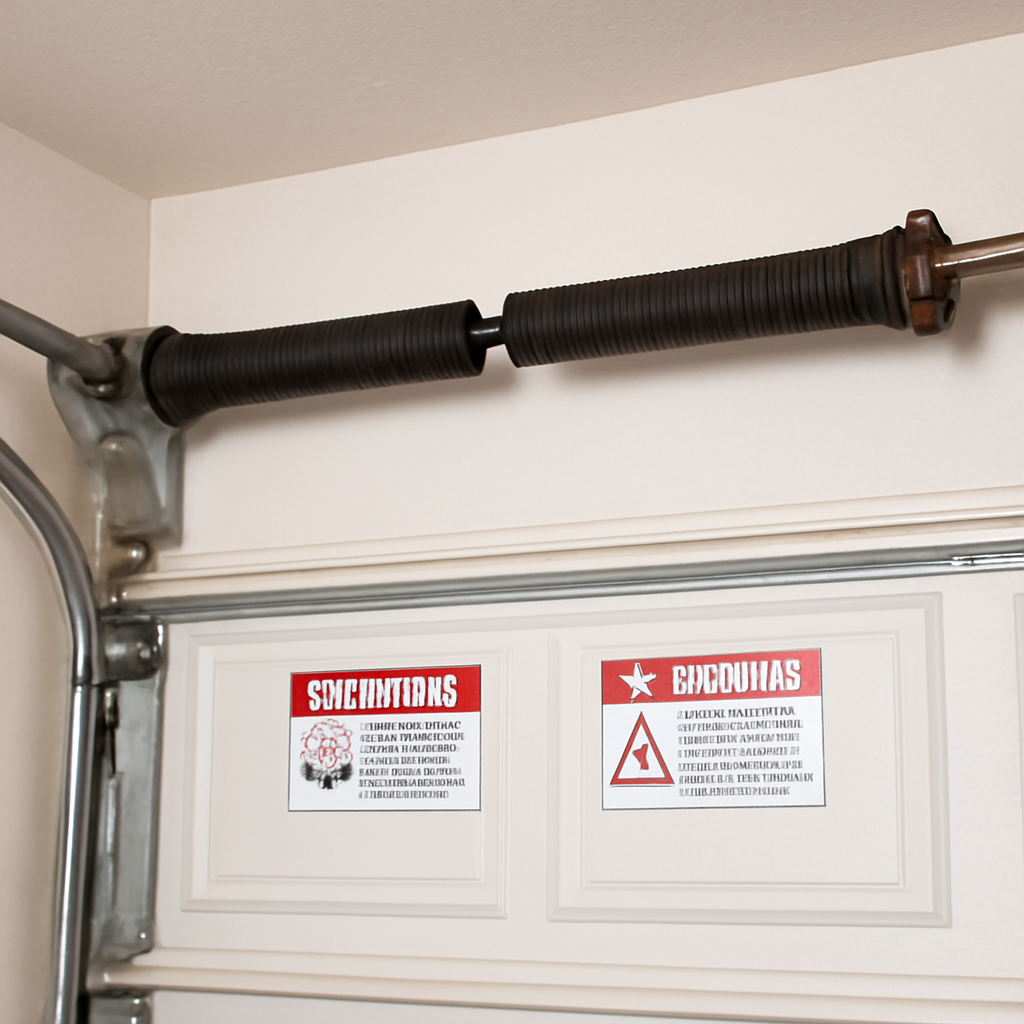
Broken torsion spring: If the trolley is connected but the door still won’t move, look at the large spring above the door. A broken spring looks like a gap in the coil — one section separated from the other. Do not attempt to replace a torsion spring yourself. These springs store hundreds of foot-pounds of tension and have caused serious injuries. Call a licensed garage door technician. A spring replacement typically costs $150–$250 including labor.
Problem 3: Door Won’t Close — Reverses or Stops
If the door goes down partway then reverses, or won’t close at all, check these in order:
Safety sensors: Look at the two small sensors near the bottom of your door tracks. The sending unit (amber LED) and receiving unit (green LED) must both be lit solid. A blinking or unlit LED means the beam is broken. Realign the sensors by loosening the bracket wing nut, rotating the sensor until the LED turns solid, and retightening. Clean both sensor lenses with a dry cloth.
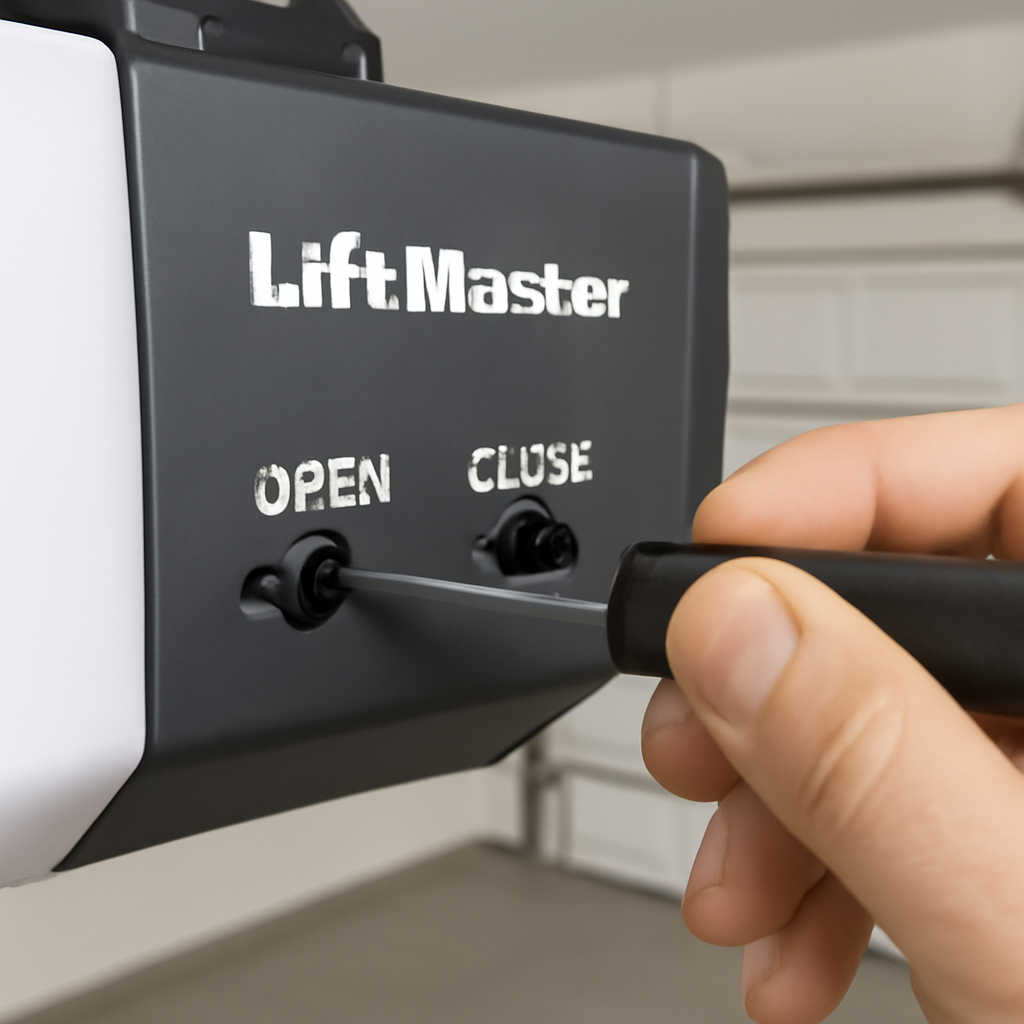
Close limit switch: If sensors are fine but the door still reverses at the bottom, the close limit may be set too far. The opener thinks the door has hit the floor before it actually has, triggering the auto-reverse. On 1/2 HP models, find the limit adjustment screws on the back or side of the motor unit — labeled OPEN and CLOSE or UP and DOWN. Turn the CLOSE screw clockwise in small increments (1/4 turn at a time) and test after each adjustment.
For a complete sensor fix walkthrough, see our guide on garage door sensor troubleshooting — the alignment steps are the same across brands.
Problem 4: Remote Not Working
Remote issues are almost always one of three things: dead battery, lost programming, or RF interference from an LED bulb in the opener.
Battery: Replace with a fresh CR2032 or A23 battery (check your remote’s back panel). Test immediately after replacement.
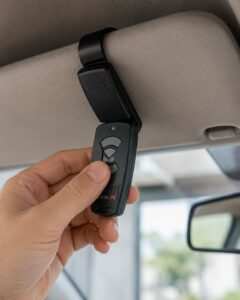
Reprogramming: If a new battery doesn’t help, reprogram the remote to the opener’s learn button. On LiftMaster 1/2 HP models, the learn button is on the back or side of the motor unit — it’s a small colored button (purple, yellow, red, or orange depending on your model’s frequency). Press and release the learn button, then within 30 seconds press and hold your remote button until the opener light flashes. That confirms successful programming.
RF interference: If you recently changed the opener’s light bulb to an LED and the remote range dropped or stopped working, the LED is likely the cause. Replace it with a standard incandescent 60W bulb or LiftMaster’s approved LED (part #41A5034).
For a full step-by-step remote fix, see our LiftMaster remote not working guide.
Problem 5: LiftMaster Error Codes
Newer LiftMaster 1/2 HP models with a display panel show numeric error codes when a fault is detected. The most common ones:
| Error Code | Meaning | Fix |
|---|---|---|
| 1-1 | Sensor wire disconnect | Check sensor wiring connections at motor unit |
| 1-2 | Sensor short circuit | Inspect wire for damage or staple cutting through insulation |
| 4-1 | Motor stall — door met resistance | Check for obstruction; adjust force settings |
| 4-2 | Exceeded max cycles without limit | Reset limit switches; run full open/close cycle |
| 6-1 | Disconnect switch open | Reconnect trolley; check emergency release cord |
For error code 4-1 specifically, see our detailed LiftMaster error code 4-1 guide which covers force adjustment and motor stall diagnosis step by step.
Problem 6: Grinding or Loud Operation
A grinding noise from a LiftMaster chain drive opener usually means the chain needs lubrication or adjustment. A loose chain (sagging more than 1/2 inch below the rail) creates a slapping sound and puts stress on the drive gear.
To tighten the chain: locate the chain tension adjustment bolt on the trolley end of the rail. Turn it clockwise to tighten until the chain has about 1/4 to 1/2 inch of slack when you press it at the midpoint. Don’t overtighten — a chain with no slack puts excessive load on the motor and gear assembly.
Lubricate the chain with a lithium-based garage door lubricant (not WD-40 — it attracts dirt). Spray a thin coat on the chain and rail, then run the door a few cycles to distribute it evenly.
If you hear a grinding noise from inside the motor unit itself, the nylon drive gear is likely worn. This is a $20–35 part and a DIY-possible repair if you’re comfortable opening the motor housing.
When to Replace Instead of Repair
Your LiftMaster 1/2 HP opener has served its purpose if:
- It’s more than 15 years old and showing multiple faults simultaneously
- The logic board has failed — replacement boards cost $60–$120, close to the cost of a new budget opener
- The motor itself has burned out
- You want smart home features (MyQ, battery backup, camera) that your current model doesn’t support
If you’re weighing repair vs. replacement, our best garage door openers with battery backup guide covers current models that include upgraded 1/2 HP and 3/4 HP options with full smart home integration.
Frequently Asked Questions
How do I reset my LiftMaster 1/2 HP garage door opener?
To reset a LiftMaster 1/2 HP opener, unplug it from the ceiling outlet for 30 seconds, then plug it back in. This clears temporary error states. To erase all remote and keypad programming, press and hold the learn button on the motor unit for 6 seconds until the LED goes out. After that, reprogram all remotes from scratch using the learn button pairing process.
Why does my LiftMaster 1/2 HP opener hum but not move?
A hum with no movement usually means the motor is getting power but can’t turn. The most common causes are a seized drive gear, a broken torsion spring making the door too heavy for the motor, or a trolley jammed on the rail. Check whether the door moves freely by hand after pulling the emergency release cord. If the door is very heavy or won’t lift manually, a broken spring is the likely cause — call a technician.
What is the lifespan of a LiftMaster 1/2 HP garage door opener?
A LiftMaster 1/2 HP opener in normal residential use typically lasts 10–15 years. LiftMaster rates most of its residential openers for 10,000 to 15,000 cycles — roughly 8–12 years at 4 uses per day. Regular lubrication of the chain or belt and annual limit switch checks can extend the lifespan toward the upper end of that range.
Can I adjust the force settings on a LiftMaster 1/2 HP opener?
Yes. LiftMaster 1/2 HP models have up-force and down-force adjustment screws on the motor unit, usually labeled with arrows or “UP FORCE” and “DOWN FORCE.” Turn the appropriate screw clockwise to increase force, counterclockwise to decrease it. Make small adjustments — 1/4 turn at a time — and test after each one. Never set force so high that the door won’t reverse when it contacts an object — this defeats the UL 325 safety requirement.
Is a LiftMaster 1/2 HP strong enough for a two-car garage door?
It depends on the door. A 1/2 HP LiftMaster opener is rated for standard double garage doors up to 18 feet wide when the door is properly balanced with functioning springs. If the springs are weak or the door is heavily insulated (over 400 lbs), a 3/4 HP or 1 HP model handles the load more comfortably and extends motor life. If your 1/2 HP opener strains or stalls frequently on a double door, the springs likely need adjustment first — not an upgrade.
Related Guides
For other LiftMaster opener guides, see How Many Openers Can You Program to a LiftMaster?, LiftMaster Garage Door Won’t Close Without Holding Button, LiftMaster Keypad Programming With No Enter Button, LiftMaster Garage Light Won’t Turn On, LiftMaster 1/3 HP Troubleshooting, How to Fix LiftMaster Error Code 1-5, LiftMaster 375UT Not Working, LiftMaster Garage Door 10 Blinks, LiftMaster Garage Door Chain Not Moving and LiftMaster Error Code 42.
For official manufacturer guidance, see LiftMaster’s official support center.